Turkey's AI Paradox: What the Digital 2027 Report Says About High Use and Low Comfort
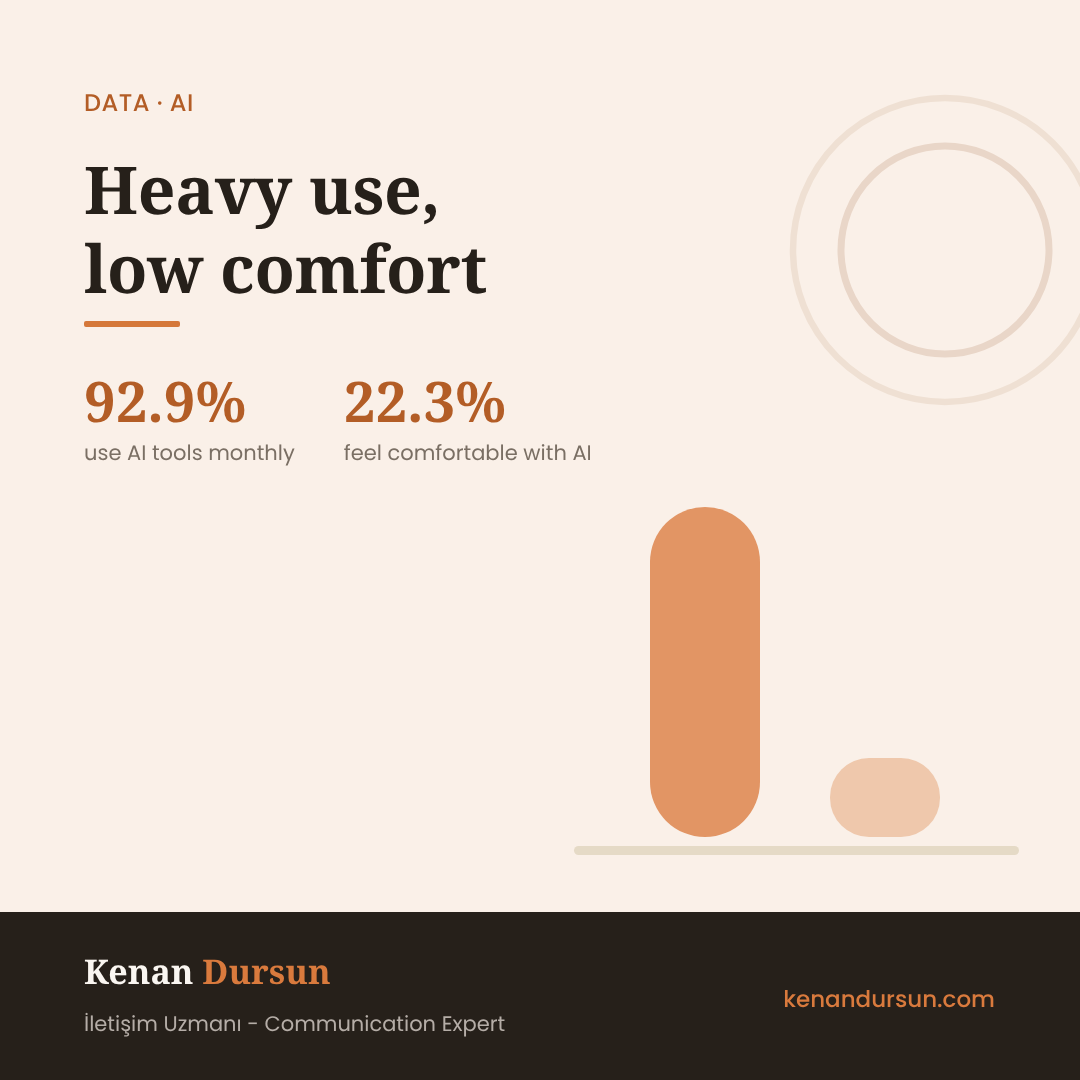
In Turkey, 92.9% of internet users use at least one AI tool every month. Ask the same people whether they feel comfortable using AI, and only 22.3% say yes. The global average is 30.3%.
Those two numbers sit side by side in the Digital 2027 Global Overview report, published on 21 October 2026, and I think they make the most instructive scene in the report for Turkey. We are talking to an audience that uses AI heavily but is not at ease with it. For a communicator or a civil society professional, that is not a picture to read as "AI use is high, so our audience is open to technology."
In this post I pick the Turkey lines that matter for communication and civil society work and interpret them. First the AI paradox, then the data on news, trust and privacy, then the platform map. At the end there are six concrete steps for organisations.
What the Digital 2027 report says, and what it does not
The report is DataReportal's annual global overview, produced with We Are Social, Meltwater and Kepios. It brings together data from sources such as GWI, the Reuters Institute, SimilarWeb and Microsoft. The global headlines: 6.15 billion internet users, 5.81 billion social media identities and 3.24 billion monthly generative AI users (up 57.2% in a year).
The basic frame for Turkey: 79.5 million internet users, or 90.4% of the population. That makes Turkey the 17th largest connected population in the world. Annual growth is only 0.3%, which means the country is close to saturation in access. Growth now comes less from new users and more from what existing users do.
Three notes to keep in mind while reading:
- Most behaviour and attitude figures come from GWI's survey for the second quarter of 2026. The sample is internet users aged 16 and over, so answers are self-reported and exclude people who are not online.
- GWI removed Russia from its sample this year. That means world averages should not be compared with last year's and read as "the world rose by this much." I only use Turkey versus world comparisons from within the same report.
- A separate Digital 2027 report for Turkey has not been published yet. This post relies on the Turkey lines inside the global report and will be updated when the country report appears.
The report contains no civil society, donation or volunteering data. I therefore build the civil society link through where audiences are, what they trust and where they see themselves. Whether NGO communication works depends on exactly those three things.
AI usage rate in Turkey: ahead of the world
According to GWI, 92.9% of internet users in Turkey used an AI tool in the past month. The world average is 85.2%, and Turkey ranks 10th. The distribution across tools is more striking: Gemini is used by 51.1%, the highest in the world, while ChatGPT sits at 51.7%, eighth.
| Indicator (internet users, 16+) | Turkey | World |
|---|---|---|
| Monthly use of AI tools | 92.9% | 85.2% |
| Gemini use | 51.1% | 28.7% |
| ChatGPT use | 51.7% | 34.7% |
| Using AI to find information | 69.0% | 60.4% |
| Using AI for advice on problems | 50.7% | 40.6% |
| Using AI for personalised recommendations | 34.6% | 31.0% |
One thing stands out: in Turkey, AI is used most for finding information and getting advice. It is a place to ask questions before it is a tool for producing text. That matters for communication. People are increasingly typing questions about your brand, your organisation or your topic into a chat window.
We use it a lot, but we are not comfortable
The paradox appears in the attitude figures next to the usage figure. In Turkey, 22.3% say they feel comfortable using AI, against a world average of 30.3%. Yet the same audience is the most convinced in the world that AI improves their own daily life: 45.6%, first in the world (world 31.7%).
| Attitude indicator | Turkey | World |
|---|---|---|
| Feel comfortable using AI | 22.3% | 30.3% |
| AI improves my daily life | 45.6% | 31.7% |
| AI will benefit society | 32.7% | 32.5% |
| AI will create jobs | 20.1% | 19.3% |
| Pays for an AI tool | 10.2% | 9.5% |
This is how I read it, and it is my interpretation, not the report's own explanation: in Turkey AI has been adopted as a tool that works in people's own lives. Expectations about its social impact sit at the world average and are not especially high. "Useful, but I am not sure."
For a communicator, the conclusion is this: in content that is about AI or produced with AI, transparency answers an unease the audience already carries. "We used AI to draft this text and a person verified this part" is not an admission of weakness. It is information that reduces discomfort. For how to place AI inside your workflow, see my post on which work should go to the machine and which should stay with people.
People ask instead of searching: the new rule of visibility
The report's SimilarWeb data gives an interesting signal at the global level. The visits index for the 10,000 most visited sites fell from 100 in the second quarter of 2024 to 93.2 in the second quarter of 2026. The time-spent index fell to 88.8. This figure is not specific to Turkey, and the report does not explain the cause on its own. But we live in a period when asking AI for information is becoming common, and the trend deserves attention.
Pew Research's 2025 data shows the mechanism: when an AI summary appears in search results, users click on links 8% of the time, against 15% when there is no summary. A growing audience gets the information without ever reaching your page.
For civil society organisations this cuts both ways. The bad news: traffic to your website may fall, because people read a summary about you instead of visiting you. The good news: AI answers prefer clear, verifiable pages that can be cited as sources. The GEO study by Aggarwal and colleagues, published at KDD 2024, reports that methods such as citing sources, adding statistics and using quotations can raise visibility in generative engines by up to 40%. Making your page a source that AI can quote is now part of visibility work.
News, trust and privacy: high interest, low trust and payment
The report's picture of news consumption in Turkey is very clear. People are interested in news, put it at the top of their reasons for going online, and get much of it from social media. But few pay for it, and worry about what is real and what is fake is high.
| Indicator | Turkey | World |
|---|---|---|
| Interested in news | 47.0% | 41.0% |
| Main reason for using the internet: news | 64.5% | 51.1% |
| Social media as a news source | 48.3% | 34.1% |
| Pays for digital news | 6.8% | 9.8% |
| Worried about what is real or fake online | 63.2% | 61.6% |
| Uses a VPN | 33.5% | 23.8% |
| Declines cookies | 49.4% | 35.1% |
| Worried about misuse of personal data | 28.9% | 30.8% |
Part of the news data comes from the Reuters Institute's Digital News Report 2026. In my media literacy post I looked at the same picture from other angles.
The privacy lines contain an interesting contrast. Turkey ranks second in the world for VPN use (33.5%, behind the UAE at 39.7%), and its cookie refusal rate is well above the world average. Yet the share worried about misuse of personal data is slightly below the world average. The report does not say why people use VPNs, and I will not guess. But the behaviour itself tells communicators enough: your audience takes its own precautions against being tracked. That can mean low tolerance for tracking pixels, persistent retargeting and forms that ask for more data than they need.
The platform map: WhatsApp and Instagram neck and neck
The list of platforms used in the past month shows why channel choice in Turkey needs to be more detailed than just saying "social media."
| Platform (past month, internet users) | Turkey | World |
|---|---|---|
| 89.2% | 56.6% | |
| 89.0% | 54.9% | |
| YouTube | 79.0% | 56.2% |
| 67.9% | 58.1% | |
| X | 54.0% | 29.0% |
| TikTok | 49.3% | 36.1% |
| Telegram | 49.0% | 30.8% |
| 24.6% | 21.3% | |
| Threads | 4.9% | 15.4% |
Instagram and WhatsApp are practically tied. Instagram is also first in the world as the "favourite platform" at 46.3% (world 17.8%), and WhatsApp's "favourite" share is 22.4%. Weekly time spent browsing social media (excluding video) is 10 hours 17 minutes in Turkey, against a world average of 7 hours 13 minutes. The average user in Turkey uses 6.83 platforms.
Three lines deserve attention. X ranks third in the world in Turkey (54.0%). Telegram is well above the world average. Threads, at 4.9%, is far below it. That is why the assumption that "everyone is already there" can mislead when you plan channels. I covered this at length last summer with Digital 2026 data in my post on channel choice. The new report is the updated version of the same frame.
An audience that does not see itself: representation and influencer data
Two lines in the report deserve particular attention from NGO communicators. In Turkey, 10.2% feel represented in advertising (world 15.8%). And 11.2% follow influencers or experts, the lowest among the 53 countries GWI measures (world 23.7%).
These two numbers need to be read together. Internet users in Turkey find advertising language distant from themselves, and they are not inclined to follow someone just because that person is popular or an expert. This fits the trust question I discussed in my creator economy post: a face or expertise is not enough to earn a follow, because familiarity and consistency matter too. For civil society organisations it could also be an opportunity: real stories from real people may feel less foreign than corporate campaign language. I offer that not as a claim but as a hypothesis worth testing.
Six steps for NGO communicators
From this data I draw six steps for your organisation that you can start this week:
- Ask AI about your own name. Ask Gemini and ChatGPT about your organisation's name, your main programme and one core question (for example, "which organisations work on X?"). Mark each answer as wrong, incomplete or correct. This is a new part of your reputation check.
- Write a clear, sourced "about" and FAQ page. Founding year, what you do, who you reach, the source of your figures. Short, verifiable sentences that AI can quote.
- Say openly how you use AI. Your audience is not at ease with AI. A short note on which content was produced with which tool and who checked it goes a long way.
- Review your channel list honestly. The weight of Instagram and WhatsApp, X and Telegram sitting above world averages, and Threads being weak should shape where you put your resources. Be where your target audience is.
- Use language that takes news trust seriously. Put a source, a date and a method next to every claim. For an audience worried about what is real, "here is our evidence" is the strongest persuasion tool.
- Keep data collection to a minimum. Cut form fields and explain your cookie and tracking use plainly. For an audience that behaves in privacy-protective ways, this is an access issue.
Frequently asked questions
What is the Digital 2027 report?
Digital 2027 Global Overview is the annual global digital behaviour report from DataReportal (We Are Social, Meltwater and Kepios). It was published on 21 October 2026 and brings together data on internet, social media, AI, news and privacy for many countries and themes.
What is the AI usage rate in Turkey?
According to GWI, 92.9% of internet users in Turkey use at least one AI tool a month, against a world average of 85.2%. That figure is self-reported and covers only internet users. Microsoft's telemetry for working-age adults shows 18.9%, and TÜİK's rate for ages 16 to 74 is 37.6%. They measure different groups, so they cannot be compared directly.
What is the most used social media platform in Turkey?
For past-month use, Instagram (89.2%) and WhatsApp (89.0%) are practically tied, followed by YouTube (79.0%) and Facebook (67.9%). As the "favourite platform," Instagram leads clearly at 46.3%.
How many internet users are there in Turkey?
Digital 2027 reports 79.5 million internet users in Turkey. That is 90.4% of the population and makes Turkey the 17th largest connected population in the world. The one-year increase is a modest 0.3%.
How common is VPN use in Turkey?
According to GWI, 33.5% of internet users use a VPN. That is second in the world after the United Arab Emirates (39.7%), against a world average of 23.8%. The report does not explain why people use them.
Sources
- DataReportal, We Are Social, Meltwater and Kepios, Digital 2027 Global Overview Report, 2026. datareportal.com
- Reuters Institute, Digital News Report 2026, Turkey. reutersinstitute.politics.ox.ac.uk
- Pew Research Center, Google users are less likely to click on links when an AI summary appears in the results, 2025. pewresearch.org
- Aggarwal et al., GEO: Generative Engine Optimization, KDD 2024. arxiv.org
- TÜİK, AI Statistics (Yapay Zekâ İstatistikleri), October 2026 (generative AI use, ages 16 to 74).
If you would like to think this through for your organisation, get in touch.
Join my WhatsApp community where we discuss civil society and communications.
Join the Community