Media Literacy in the Age of Disinformation: Why Is Trust in News So Low in Turkey?
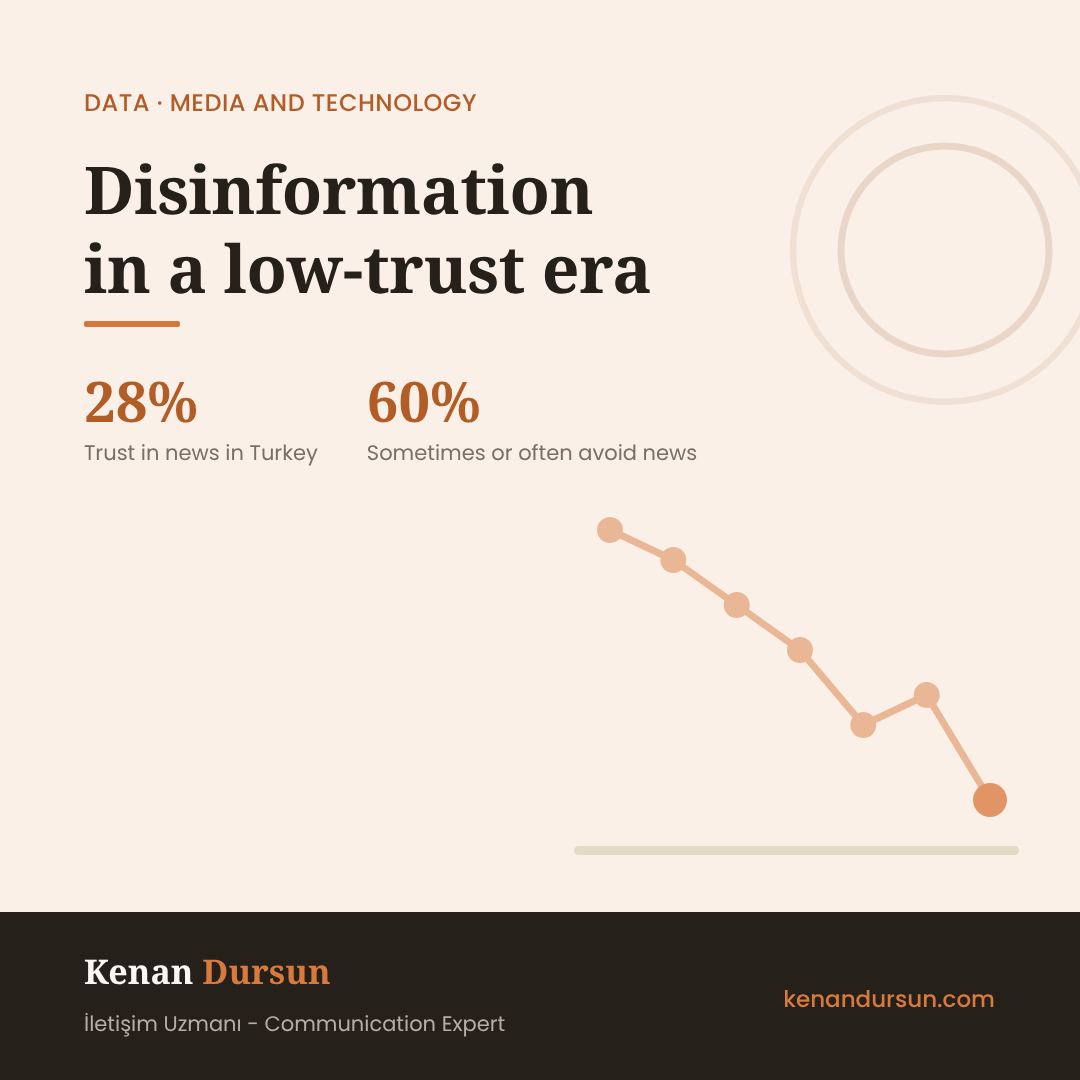
If the first thing that crosses your mind when you read a news story is "is this actually true?", you are not alone. According to the Reuters Institute Digital News Report 2026, only 28% of people in Turkey say they trust most news most of the time. A year earlier the figure was 33%.
Debates about disinformation usually begin and end with fake news. I think the real problem runs deeper: people are not only falling for false information, they are also giving up on believing accurate information. Where trust has worn thin, even a carefully verified story gets waved away with "who knows who is behind this".
In this piece I first pin down the terms: what disinformation means, how it differs from misinformation, and what media literacy is. Then I look at the Turkish data, at where trust has moved, and at why our brains are so easy to persuade. At the end there is a practical checklist for individuals and for civil society organisations.
What is disinformation?
Disinformation is false information that is created or spread knowingly, in order to mislead, cause harm or gain an advantage. The key word is "knowingly". Someone who shares the same false claim in good faith, believing it to be true, is spreading misinformation, not disinformation.
One of the clearest frameworks for this distinction is Information Disorder, the report Claire Wardle and Hossein Derakhshan prepared for the Council of Europe in 2017. It splits what Turkish speakers loosely call "bilgi kirliliği" (information pollution) into three types, based on two questions: Is the information false? Does the person sharing it intend harm?
| Type | Is it false? | Intent to harm? | Example |
|---|---|---|---|
| Misinformation | Yes | No | Forwarding a years-old flood photo to the family group, believing it shows today's event |
| Disinformation | Yes | Yes | Fabricating a document or a quote to damage an organisation and pushing it into circulation |
| Malinformation | No, it is genuine | Yes | Exposing someone's real but private details (home address, health status) to target them |
The practical lesson of the table: the same piece of content can change category as it changes hands. Disinformation produced on purpose by a troll network becomes misinformation once your relative forwards it to a WhatsApp group in good faith. So if you are looking for an example of disinformation, look at intent and circulation, not only at the content. Countering it means targeting the sharing chain in between, not just the original source.
What is media literacy?
The US-based National Association for Media Literacy Education (NAMLE) describes media literacy as the ability to access, analyse, evaluate, create and act using all forms of communication. My own short version is simpler: turning "who made this, why, how, and for whom?" into a reflex whenever you meet a piece of content.
Media literacy is not a single skill. Three related terms that people often search for are really different strands of the same muscle:
Digital media literacy
Knowing why an algorithm puts something in front of you, how to trace an image back to its origin, and how to read search results. It looks technical, but at heart it is a discipline of attention.
Critical media literacy
Looking at the structure behind the content: ownership, business model, framing, whose voices are heard and whose are not. The Reuters Institute's Turkey profile notes that ownership of mainstream media is highly concentrated in groups close to the government. Reading the news without this context is like navigating without a map.
Social media literacy
Here the question is not only "is it true?" but also "should I share it?". According to the same report, 38% of respondents in Turkey share news via social media, messaging or email. Whether we like it or not, we are all publishers now.
One caveat: media literacy is not training in doubting everything. There is a thin line between not believing every story and believing no story at all, and as we will see below, the second extreme is at least as dangerous as the first.
Trust in news in Turkey: what 28% and 60% tell us
The 2026 Reuters report covers 48 markets and around 97,500 respondents. Turkey's picture in brief:
- Trust in news: 28%. Down 5 points in a year. The global average is 37%, which the report describes as the lowest global figure since it began measuring trust in 2015.
- News avoidance: 60%. Together with Bulgaria, Croatia and Greece, Turkey is one of four countries where 60% or more of the population sometimes or often avoid the news. The global average is 42%.
- News comes through platforms. According to the Turkish summary published by the fact-checking organisation Teyit, Instagram is the most used platform for news at 48%, followed by YouTube (38%), Facebook (31%), WhatsApp (29%), TikTok (17%) and X (16%). News use of X fell by 7 points in a year.
- AI chatbots: 14%. The share using AI chatbots for news rose by 6 points; the global average is 10%.
When I put these numbers side by side, I do not see a picture of indifference. I see a picture of self-defence. People who avoid the news are usually choosing not to be exhausted or deceived, rather than choosing to be uninformed. But the gap does not stay empty: accounts on Instagram feeds, family groups and, increasingly, chatbots fill the space news organisations leave behind.
News now comes from a person rather than an institution. We weigh a piece of information by asking "who shared it?" rather than "which paper reported it?". That is exactly the soil in which disinformation thrives: a flow where the source disappears and only the sharer is visible.
Where did trust go? From institutions to the neighbourhood
For the global picture I turn to the 2026 Edelman Trust Barometer. An important note: the survey, conducted with nearly 34,000 people in 28 countries, does not include Turkey. The figures below describe a global trend, not Turkey.
The report's title says it all: "Trust Amid Insularity". Seven in ten respondents are unwilling or hesitant to trust someone with different values. Following social upheavals of recent years, net trust in national government leaders has fallen by 16 points and in major news organisations by 11 points. Over the same period, trust in neighbours, family and friends has risen by 11 points.
Two figures connect directly to the disinformation debate. 65% worry that foreign actors are deliberately injecting falsehoods into their national media. Meanwhile, the share who get news at least weekly from ideologically different sources has dropped to 39%. The more people fear contamination, the more they retreat into their own echo chambers, and the echo chamber becomes a new site of contamination.
The Kömüre Veda ("Farewell to Coal") Communication Guide, published in 2026 by ECF, the Istanbul agency Senfonico and the research company KONDA, illustrates this shift in the Turkish context with a concrete table:
| Area | Trusted in the past | Trusted now |
|---|---|---|
| Health decisions | Doctors and experts | Family and friends (45%) |
| Financial decisions | Bank adviser | Social circle, finfluencers |
| Purchases | Brand communication | Consumer reviews |
For an NGO communicator, this is both bad and good news. The bad news: an organisation's logo no longer generates trust on its own. The good news: trust is not disappearing, it is relocating. It is moving to the neighbourhood, the workplace, the WhatsApp group. I explained in more detail why closed channels matter so much for NGO communication in my post on channel choice data in Turkey.
Why are our brains so easy to persuade?
Explaining disinformation only through "people with bad intentions" falls short; for content to stick, it needs a mind that is ready for it. The Kömüre Veda guide describes two defences the brain uses against new information.
The first is cognitive dissonance: when the brain meets information that challenges an existing behaviour or belief, it looks for an explanation that closes the matter. A false but comforting explanation wins over a true but uncomfortable story. The second is filtering speed: according to the guide, the problem is not shrinking attention spans but faster filtering. Content either sticks in the first seconds or is discarded. That makes it a race in which the emotional and simple beats the complex and accurate.
Jonah Berger and Katherine Milkman's study of New York Times articles completes the picture: what drives sharing is not whether content is positive or negative, but how much emotional arousal it creates. Anger, anxiety and awe spread; sadness and contentment do not. People who produce disinformation know this very well.
The "Homo Dubitans" chapter of Senfonico's Homo Glitchus 2026 report describes how doubt itself becomes a trap. When uncertainty becomes unbearable, a conspiracy theory offers "a dark but comforting order". The report explains this through apophenia: the tendency to see meaningful connections between unrelated pieces of data. It also cites bot audits showing that, about 20 minutes after engaging with a single conspiracy video, a feed fills largely with conspiratorial, anti-institutional and misogynistic content.
That is why reducing media literacy to "be more sceptical" is dangerous. A person who trusts nothing eventually trusts whoever tells them the best story.
AI, deepfakes and digital provenance
According to the 2026 Reuters report, 62% of respondents globally are concerned about what is real and what is fake online, up 4 points in a year. With synthetic images, audio and video now so cheap to produce, that concern is no surprise.
My observation is this: the question "is this image fake?" is becoming impossible to answer. Naked-eye tips for spotting deepfakes (blinking, finger counts, blurry ears) go out of date with every new model. So the question is shifting from "is it fake?" to "where did it come from?". The title of AA Teyit Hattı's article on 2026 AI trends captures this shift: digital provenance against deepfakes and synthetic content. (AA Teyit Hattı is the fact-checking desk of Turkey's state news agency, Anadolu Agency.)
Digital provenance means recording where, when and with which device or software a piece of content was created, and how it was altered afterwards. The C2PA standard and the "Content Credentials" built on it are the best-known initiative in this area. Instagram head Adam Mosseri reached a similar conclusion in his end-of-2025 reflections: we need to stop assuming that what we see is real, and giving genuine media a digital fingerprint is more workable than chasing down fakes.
The takeaway for organisations is clear: document the origin of the images and videos you produce, and keep your archive in order. I discussed where to use AI in your communication and where not to in a separate post; presenting a synthetic image as a real field photo is at the very top of that list.
What is Turkey's disinformation law?
What the Turkish public calls the "disinformation law" is Article 217/A of the Turkish Penal Code, added by Law No. 7418, published in the Official Gazette on 18 October 2022. The offence is titled "publicly disseminating misleading information to the public".
The article criminalises publicly spreading false information about the country's internal or external security, public order or public health, solely with the motive of creating anxiety, fear or panic among the public, in a way that is capable of disturbing public peace. The penalty is one to three years' imprisonment. If the offender conceals their real identity or the offence is committed within the activities of an organisation, the penalty is increased by half.
The provision has been debated since the day it was adopted. Supporters see it as a tool against disinformation, while press associations and freedom of expression organisations have raised concerns that its terms can be interpreted broadly and may have a chilling effect on journalism. The practical point for communicators: especially during disasters and crises, not sharing unverified information from institutional accounts is a matter of both ethical and legal care.
What can we do about information pollution?
Before you share: a personal verification checklist
- Take an emotional pause. If the content made you angry, scared or very happy, stop. High emotional arousal is the fastest route to the share button.
- Read laterally. In a study by Sam Wineburg and Sarah McGrew at Stanford, professional fact-checkers did not study a website at length; they quickly opened new tabs to see what others said about it. Read what outside sources say about the site, not the site itself.
- Go to the primary source. When you see "experts warn" or "according to research", ask which experts and which research, and find the original document.
- Run a reverse image search. Use tools such as Google Lens or TinEye to check when and where a photo first appeared. For video, take a screenshot and do the same.
- Check the date and context. Much information pollution is not entirely fabricated but old content stripped of its context. An old event can circulate as footage of a new one.
- Check fact-checking platforms. In Turkey, organisations such as Teyit and AA Teyit Hattı already examine most claims in circulation.
Five steps for organisations and NGOs in a low-trust environment
- Become a trust broker. Edelman 2026 describes "trust brokering" as surfacing common interests between parties who distrust each other, rather than trying to change people's minds. On a divisive issue, what people expect from an organisation may be bringing the sides to the same table, not taking sides.
- Do not say "trust us"; show the process. Say openly where your data comes from, what your method is, what you know and what you do not. Trust is not something you can demand; it is earned through a visible process.
- Do not hide corrections. When you make a mistake, add a correction note instead of quietly deleting the content: what changed, when and why. Transparent correction is one of the strongest trust signals in a low-trust environment.
- Find local and concrete messengers. The formula that cuts across all segments in the Kömüre Veda guide is "local, concrete and a trusted source". Let a teacher, a neighbourhood head or a volunteer on the ground speak, rather than the institutional account.
- Be prepared. Decide in advance who will respond, on which channel and within how many hours, if a false claim about your organisation starts to spread. Prepare short pieces that explain recurring false claims before they come up.
To the question "how do we deal with false information?", my answer has gradually become this: instead of chasing each falsehood one by one, speak where people already place their trust, through people they trust, with an open and consistent process. Disinformation grows in a trust vacuum, and there is no shortcut to filling that vacuum.
Frequently asked questions
What does disinformation mean?
Disinformation is false information that is created or spread knowingly, in order to mislead, cause harm or gain an advantage. Fake documents, invented quotes and images deliberately stripped of their context are typical examples. What defines it is that the information is known to be false and is spread anyway.
What is the difference between disinformation and misinformation?
The difference is intent. Misinformation is false content shared in good faith by someone who believes it is true; disinformation is spread knowingly and deliberately. There is also malinformation: genuine information, such as someone's private details, exposed in order to cause harm.
What is media literacy and why does it matter?
Media literacy is the ability to access, analyse, evaluate, create and act thoughtfully with all kinds of media content. In Turkey, where trust in news has fallen to 28% and news largely travels through social media, it is the basic tool for telling reliable information apart from the rest. Digital, critical and social media literacy are different dimensions of the same skill.
What is Turkey's disinformation law?
The so-called disinformation law is Article 217/A of the Turkish Penal Code, added in 2022 by Law No. 7418. It criminalises publicly spreading false information about internal or external security, public order or public health, solely to create anxiety, fear or panic and in a way capable of disturbing public peace. The penalty is one to three years' imprisonment.
How can I tell whether a news story is true?
First notice the emotion the content triggers in you and pause before sharing. Then research the source through lateral reading, find the primary document, check images with a reverse image search and verify the date. Fact-checking organisations such as Teyit and AA Teyit Hattı in Turkey also examine most claims in circulation.
Sources
- Reuters Institute, Digital News Report 2026: Turkey, 2026
- Reuters Institute, Digital News Report 2026: Executive Summary, 2026
- Teyit, 2026 Reuters Enstitüsü Dijital Haber Raporu: Türkiye haberden kaçınmada dünyanın önünde (in Turkish), 2026
- Edelman, 2026 Edelman Trust Barometer: Trust Amid Insularity, 2026
- Council of Europe (Claire Wardle, Hossein Derakhshan), Information Disorder: Toward an Interdisciplinary Framework for Research and Policy Making, 2017
- NAMLE, About NAMLE, accessed 2026
- Stanford (Sam Wineburg, Sarah McGrew), Lateral Reading and the Nature of Expertise: Reading Less and Learning More When Evaluating Digital Information, 2017
- Hukuki Haber (Asım Ekren), Soru ve Cevaplarla Basın Yayın Yoluyla Halkı Yanıltıcı Bilgiyi Alenen Yayma Suçu (in Turkish), 2023
- AA Teyit Hattı, 2026 yapay zekâ trendleri: Deepfake ve sentetik içeriklere karşı dijital köken (in Turkish), 2026
- C2PA, Frequently Asked Questions, accessed 2026
- The Decoder, Instagram CEO argues humans must override their instinct to trust what they see online, 2026
- ECF, Senfonico and KONDA, Kömüre Veda İletişim Rehberi (Farewell to Coal Communication Guide), 2026
- Senfonico, Homo Glitchus: İnsanlık Hali, 2026
- Jonah Berger and Katherine L. Milkman, What Makes Online Content Viral?, Journal of Marketing Research, 2012
If you would like to think this through for your organisation, get in touch.
Join my WhatsApp community where we discuss civil society and communications.
Join the Community