How AI Tools Are Changing Communication Work: What to Hand to the Machine, What to Keep Human
The first draft of a press release now takes a few minutes. So does the transcript of a panel, the summary of a long report, or one message adapted for three different audiences. That is why the question in communication teams has changed. It is no longer "Should we use AI tools?" but "Who actually does what in this job now?"
In this piece I want to look past individual tasks and at the profession itself. How are AI tools splitting up a communicator's day? Which work moves to the machine, which should stay with people, and in the work they do together, who leads and who checks? At the end I suggest a practical way for small teams and civil society organisations to set up that division of labour.
My short answer: machines have made production cheap. They have not made verification, context or accountability cheap. That is exactly where a communicator's value is moving.
What the numbers say: the tools are on the desk, the division of labour is not
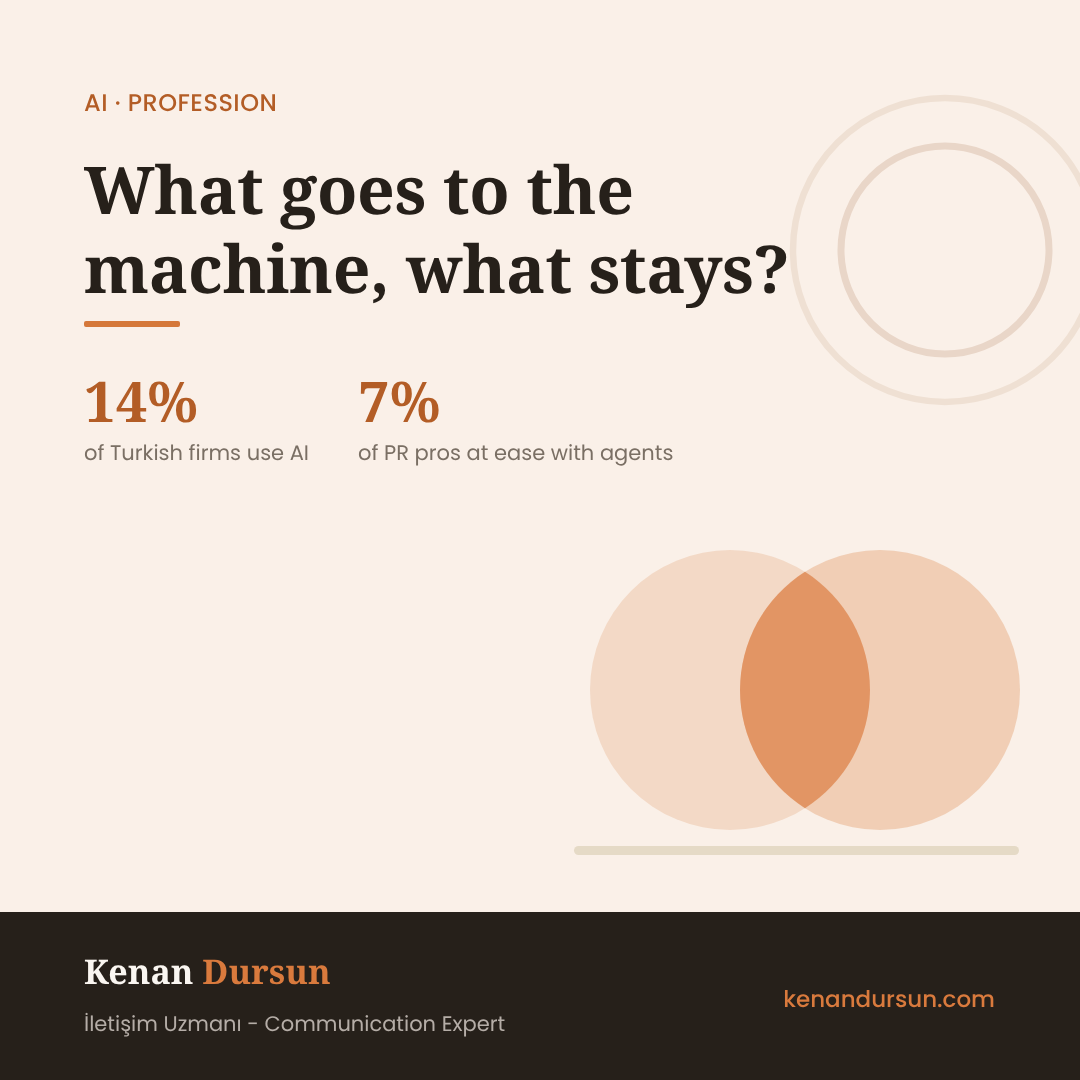
According to the AI statistics published by TurkStat, Turkey's national statistics office, in October 2026, the share of enterprises with 10 or more employees using any AI technology rose from 7.5% to 14% in a single year. The share of people aged 16 to 74 using generative AI rose from 19.2% to 37.6%. Both figures roughly doubled in twelve months.
A less discussed detail sits in the same data. Among enterprises that considered using AI but did not, 72.3% cited a lack of expertise, 66.4% uncertainty about legal consequences and 65.4% concerns about data protection and privacy. In other words, the barrier is not the tool. It is not knowing how to use it, or who will be responsible.
Data from inside the profession tells a similar story. In Muck Rack's survey of 564 PR professionals, carried out in December 2025, generative AI use has levelled off at 76%, up from under 30% in 2023. And 98% of users say they always or often edit the text that AI produces. What does that mean? The tool has spread, but the work still ends on a human's desk.
One Turkey-specific detail: according to figures from We Are Social and Meltwater's Digital 2026 report, 94.49% of AI-driven web referrals in Turkey come from ChatGPT, against a global average of 80.92%. Leaning this heavily on a single tool means our habits and our risks are concentrated in the same place.
AI tools and their uses: which tool does what in communication work?
To answer "where is AI used?" from a communicator's point of view, it is more useful to start from types of work than from product names. AI programs and apps change every month, but the categories stay fairly stable. The table below is not a product list; each category has only a couple of well-known examples.
| Category | What it does in communication work | Well-known examples | The human share |
|---|---|---|---|
| Writing and editing | Drafts, headline options, simplifying, adjusting tone | ChatGPT, Claude, Gemini | Setting the message and accuracy, protecting the organisation's voice |
| Research and summarising | Summaries of long documents, reports and regulations, source scanning | NotebookLM, Perplexity | Reading the critical passage in the original source |
| Transcription and translation | Meeting and interview transcripts, translation, language checks | Whisper-based tools, DeepL | Consent, proper names, rights-based language |
| Visuals and presentations | Draft decks with AI presentation makers, visual variations, template adaptation | Gamma, Canva's AI features, Copilot in PowerPoint | Representation, visual ethics, brand consistency |
| Data analysis | Cleaning tables, summarising metrics, grouping open-ended survey answers | Analysis features in chat assistants and spreadsheet tools | Asking the right question, interpreting the result |
| Social media scheduling | Content calendars, post variations, timing suggestions | Assistants in scheduling tools such as Metricool and Buffer | Sensitivity to the news agenda, pausing posts in a crisis |
I have already written about how to use these categories at task level, and especially where civil society should not use them, in where to use AI in NGO communication, and where not to. Here I want to step back and ask a different question: once these tools are on the desk, what becomes of the communicator's job?
From producer to editor: how the communicator's role is shifting
In his 2023 essay "Unbundling AI", Benedict Evans says he used to describe the previous wave of machine learning as giving you "infinite interns", and adds this about ChatGPT:
ChatGPT is an intern that can write a first draft, or a hundred first drafts, but you'll have to check it.
Benedict Evans, "Unbundling AI", 2023
The analogy captures the division of labour well. An intern produces a lot, fast, but does not know what is true, what to say to whom, or what should never be said at all. In an office full of interns, the most valuable person is not the one who writes the most but the one who gives the best direction and does the best checking.
So I describe the communicator's new role as four hats:
- Context builder. The person who tells the machine who the organisation is, who the audience is and what is sensitive. We now talk about this less as "prompt writing" and more as "context engineering". The short rule: you cannot ask for what you do not know.
- Editor. The person who brings a draft into the organisation's voice, the right tone and the right length.
- Curator. The person who picks one of ten options and can explain why the other nine were dropped. This is where taste comes in. Originality deserves its own article; for now I will just say that a team that cannot choose produces average content.
- Verifier. The person who checks that the figure, the quote, the name and the date actually exist, and who can answer for them after publication.
Microsoft's Work Trend Index 2025, based on around 31,000 knowledge workers in 31 countries, even gives this shift a name: the "agent boss", someone who builds, delegates to and manages AI agents. In the same study, 78% of leaders say they are considering hiring for AI-specific roles. One of the principles Ethan Mollick proposes in Co-Intelligence points the same way: be the human in the loop.
Machine, human, together: a division of labour matrix for communication work
When I work with teams, the method that helps most is writing down two questions for every task. Who starts and leads this work? Who checks and approves it? The matrix below is a starting point; adapt it to your own team.
| Task | Who leads | Who checks | Note |
|---|---|---|---|
| Meeting and interview transcripts | Machine | Human (spot checks) | Speakers' consent is essential |
| Summaries of long documents | Machine | Human | Critical passages read in the source |
| Translation | Machine | Human | Organisation names and legal terms |
| First drafts of releases and news | Together | Human | The human sets the message, the machine builds the draft |
| Adapting for audiences | Together | Human | The core information must not change |
| Social media calendar | Together | Human | Agenda and crisis control stay human |
| Draft decks and visuals | Together | Human | Representation and visual ethics |
| Metrics report | Together | Human | Interpretation and recommendations stay human |
| Message strategy and positioning | Human | Human (leadership) | The machine is only a thinking partner |
| Crisis statement | Human | Human (leadership, legal) | It commits the organisation |
| Press and stakeholder relations | Human | Human | Relationships cannot be delegated |
| Testimonies and case stories | Human | Human (the story's owner) | Editing yes, generating no |
One pattern stands out: the machine never appears in the "who checks" column. The profession sits in the same place. In Muck Rack's study, 89% of PR professionals say they would be more comfortable working with AI agents if there were clear human approval before anything is published or sent, while only 7% are comfortable letting agents act on their behalf.
What stays human? Relationships, trust, context and accountability
The World Economic Forum's Future of Jobs Report 2025 finds that 69% of the roughly 2,800 skills it assessed have low or very low potential to be replaced by generative AI, and that none have very high potential. In communication work, I group what stays with people under five headings.
Relationships and trust brokering
A relationship with a journalist, a local authority, a volunteer or a rights holder is not a text. It is trust built up over time. The 2026 Edelman Trust Barometer reports that 70% of people are unwilling or hesitant to trust someone with different values, and proposes "trust brokering": surfacing the shared interests of parties who do not trust each other. Turkey is not among Edelman's 28 countries, so this is a global finding. But it describes the communicator's job well, and it is not something to hand to a machine.
Local context
A model does not know on its own how a word will be read in a particular city, or which spokesperson will build trust with one audience and provoke another. It knows if you tell it, and only as much as you know.
Offloading the burden, not the thinking
Senfonico's Homo Glitchus 2026 trend report, published by a Turkish communication agency, cites Ipsos Global Trends data showing that 76% of consumers in Turkey say there is too much information and making decisions is exhausting. It describes influencers as a kind of "decision prosthesis". Inside an organisation, AI can easily become the same kind of prosthesis, the moment we start handing over not the fatigue of thinking but the thinking itself. Readers notice straight away.
Ethical judgement and crisis moments
Whether to use a child's photo, how to tell a story of harm, what to concede in a crisis statement: these are ethical decisions. Speed matters in a crisis, but the cost of one wrong sentence is far higher than the cost of half an hour.
Accountability
When a wrong figure is published, "the tool wrote it" is not an answer. Every text released in the organisation's name has a human owner. That is the real test of any division of labour: who signs it off?
New competencies: how the communicator's skill set is changing
According to the Future of Jobs Report 2025, employers expect 39% of workers' core skills to change by 2030. The fastest-growing skill is AI and big data. Yet the core skill employers value most today is analytical thinking, followed by resilience and flexibility, leadership and social influence, and creative thinking. Empathy and active listening are also in the top ten.
The profession's own data is more specific. In Muck Rack's 2026 study, PR professionals say the skills most needed to work well with AI are prompt writing (85%) and ethical decision-making (71%), with tool evaluation and data literacy also on the list. I translate this into five competencies for communication teams:
- Writing context: bringing the organisation, the audience, sensitivities and good examples together in a single brief.
- A verification reflex: going back to the primary source for every figure, quote and name.
- Editing: spotting fluent but empty text and cutting it down.
- Data literacy: being able to question a table or chart the machine produces.
- Ethical and legal awareness: knowing the rules on data protection, copyright, consent and disclosure.
One warning. In the same study, 77% worry that newer communicators will lean on the tools without learning the profession's basic principles. Someone who has never learned to write a press release will struggle to fix one written by a machine. That is why teams should leave junior staff room to write by hand.
Risks: hallucination, data protection, bias, over-reliance and disclosure
Stanford HAI's AI Index 2026 shows documented AI incidents reaching a record 362 in 2025. For communication teams, five risks stand out:
- Hallucination and verification: a model can confidently produce a report, quote or figure that does not exist. In Muck Rack's study, 63% see "unscrutinised AI output" as a risk.
- Personal data: pasting a donor list, a beneficiary case or staff details into a chat tool means sending that data outside the organisation. Turkey's data protection authority (KVKK, which enforces the country's GDPR-style law) published a guide on generative AI and personal data in November 2025; it is worth everyone on the team reading. Among PR professionals, 69% say they avoid entering personally identifiable information into these tools, and 77% avoid financial data.
- Bias: models carry the patterns of their training data. In image generation, look carefully at who is drawn as "the expert" and who as "in need of help".
- Over-reliance: a workflow that depends on one tool, one provider and one staff member's prompting knowledge is fragile.
- Disclosure: decide in advance when you will flag AI's contribution. In Muck Rack's data, the share of brands wanting agencies to disclose AI use "all the time" fell from 37% to 29%, while "some of the time" rose from 17% to 26%. Expectations are becoming more nuanced, which makes writing your own rule even more necessary.
A 30-day division of labour plan for small teams and NGOs
In a small communication team, often a team of one, the division of labour is not an org chart but a habit. To the question "Which tool should we get?", my advice is always the same: write down the workflow before choosing the tool.
Week 1: Inventory
For one week, everyone on the team lists the communication tasks they do and notes which AI tool, if any, they used for each. The "quiet use" nobody talks about is usually more than people assume.
Week 2: The matrix
Fill in the table above with your own tasks: a "who leads, who checks" column for each. Write down your red lines (personal data, crisis statements, testimonies).
Week 3: A context file and a pilot
Prepare a one-page context file with your mission, audiences, voice and tone rules, phrases to avoid and examples of good writing; it fits well as an annex to your one-page communication plan. Then run a pilot on a single recurring task, such as event announcements or a monthly report summary, and record the time spent and how much editing was needed.
Week 4: Rules and review
Look at the results. Did you save time? Did quality drop? What did verification catch? Then write a half-page usage rule and share it with leadership. Also decide explicitly where the saved time will go: relationships, fieldwork, measurement.
Frequently asked questions
What are AI tools, and what do they do in communication work?
AI tools are software that automates or speeds up work involving text, images, audio and data. In communication they are used most for writing and editing, research and summarising, transcription and translation, draft decks and visuals, data analysis and social media scheduling. The common rule across all of them is that a person checks and approves the output.
Will AI take communication professionals' jobs?
The data points less to jobs disappearing than to their content changing. Drafting is shifting to machines, while context building, editing, verification, relationship management and ethical judgement stay with people. According to the World Economic Forum, 69% of the skills it assessed have low or very low potential to be replaced by generative AI.
Where should AI be used in communication, and where not?
It works well for repetitive, verifiable, low-risk tasks such as transcripts, summaries, translation and first drafts. Content containing personal data, crisis statements, generating testimonies or case stories, and unverified figures should not be left to the machine. Asking "who leads, who checks?" for each task is a reliable way to decide.
Can AI presentation makers be trusted?
AI presentation makers are a good starting point for structure and design. But figures, sources and how people are represented in the visuals must always be checked. In an organisational presentation, the final word belongs to someone who knows the audience and the context.
Should we tell readers when we use AI?
For routine work like transcription or proofreading it is usually unnecessary. If a substantial part of an image or text was generated with AI, saying so protects trust. The healthiest approach is to set a written rule in advance for when you will disclose.
Sources
- TurkStat (TÜİK), Artificial Intelligence Statistics, 2026 (coverage: Bloomberg HT, 2 October 2026; detailed breakdown: Alomaliye)
- Muck Rack, The State of AI in PR 2026, 2026
- Microsoft, 2025 Work Trend Index: The Year the Frontier Firm Is Born, 2025
- World Economic Forum, The Future of Jobs Report 2025, 2025
- Stanford HAI, AI Index Report 2026, 2026
- Edelman, 2026 Edelman Trust Barometer: Trust Amid Insularity, 2026
- Benedict Evans, Unbundling AI, 2023
- KVKK (Turkish Personal Data Protection Authority), Generative AI and Personal Data Protection Guide (in Turkish), 2025
- We Are Social and Meltwater, Digital 2026 Global Overview Report (reported by Turkish Minute, 2026)
- Senfonico, Homo Glitchus: The Human Condition, 2026
- Ethan Mollick, Co-Intelligence: Living and Working with AI, 2024
If you would like to think this through for your organisation, get in touch.
Join my WhatsApp community where we discuss civil society and communications.
Join the Community