Are NGOs Talking in the Wrong Places? Channel Choice Data from Turkey
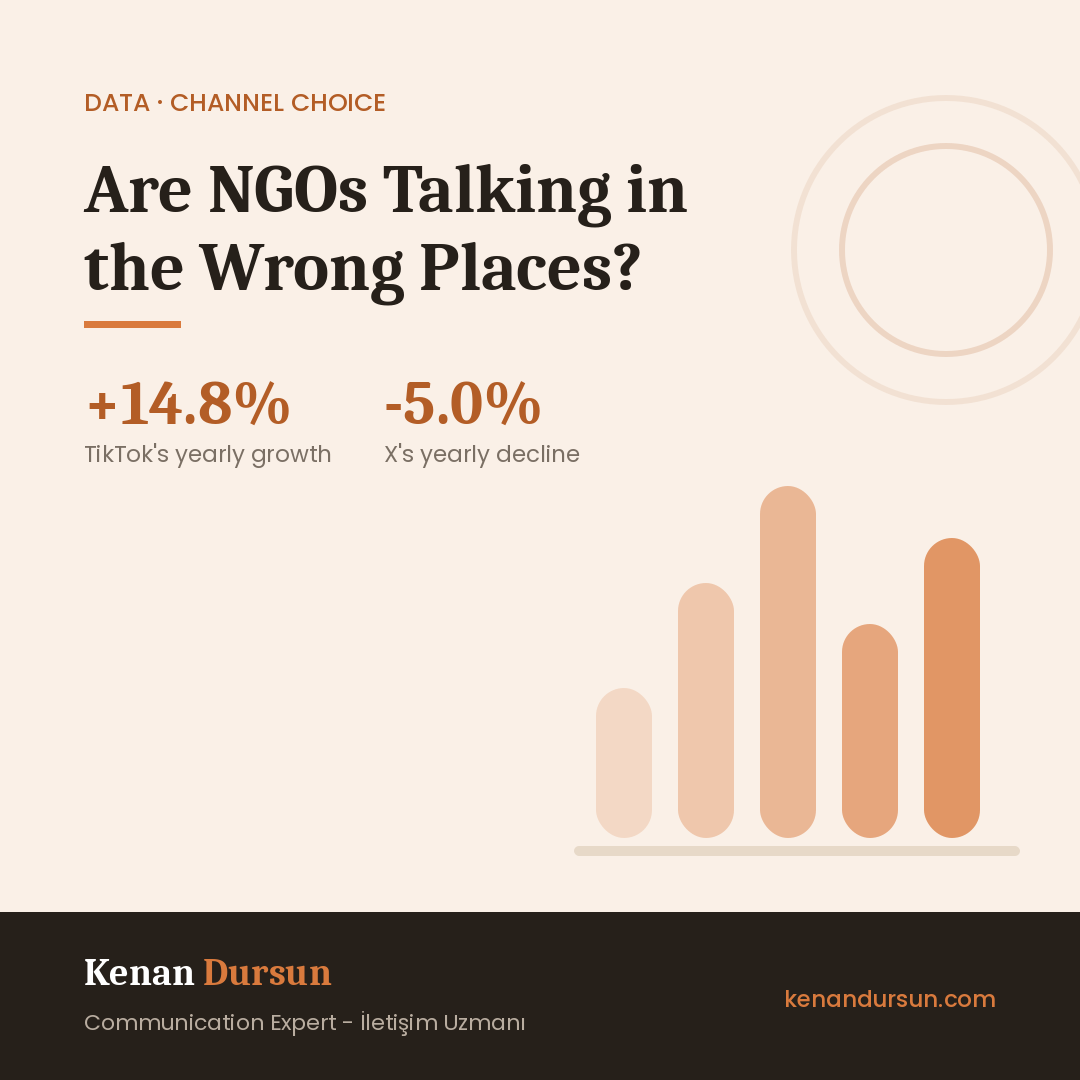
Civil society communicators are on X. The people they want to reach are on TikTok. If that sounds like an overstatement, let me put two data sets side by side.
For years I have been running a WhatsApp community made up of people who work in civil society. From time to time I run polls there: which platforms do you use, do you use a VPN, what frustrates you most in job applications. When I compared those poll results with Turkey's national digital data, a picture emerged that I did not expect.
The problem is not budget. The problem is that organisations choose their channels based on the communicator's own habits rather than the audience's.
Turkey's digital picture in 2026
According to DataReportal's Digital 2026: Turkey report:
- 77.5 million internet users, or 88.3% of the population
- 62.3 million social media user identities, up 4.8 million (+8.3%) in a year
- 81.9 million mobile connections
Platform by platform:
| Platform | Users | Year-on-year |
|---|---|---|
| 62.3 million | +10.3% | |
| YouTube | 57.9 million | +0.7% |
| TikTok | 44.9 million (18+) | +14.8% |
| 34.7 million | +1.0% | |
| 21.0 million | +16.7% | |
| X (Twitter) | 18.5 million | -5.0% |
| Snapchat | 16.2 million | -1.2% |
The two sentence summary: TikTok and LinkedIn are growing fast, X is shrinking. X now reaches less than half of TikTok's audience in Turkey and is the only major platform in decline.
So where are civil society communicators?
I asked the same question in my own community. In the larger of two polls, close to 200 people responded to "Which digital media platforms do you actively use?":
| Platform | Votes |
|---|---|
| 207 | |
| 191 | |
| YouTube | 125 |
| 98 | |
| X (Twitter) | 96 |
| Telegram | 48 |
| 31 | |
| TikTok | 26 |
| 26 | |
| Snapchat | 14 |
This is not a representative survey. It is a voluntary poll inside my own community and it does not speak for Turkey. But that is exactly what makes it useful: it shows the personal digital habits of the people who actually do civil society communications. Channel decisions are largely made at their desks.
Three mismatches
1. We are over-represented on X
Nationally, X reaches 18.5 million people and is shrinking. Yet in my civil society community, close to half of respondents use it actively. That explains the most common reflex in the sector: when a statement goes out, it goes to X first.
X still has a function for civil society. Journalists, academics and decision makers are there. But that is a narrow and narrowing public. Communicating on X usually means talking within the sector rather than reaching the public. These are not the same thing, and reports often present them as if they were.
2. We are absent from TikTok
This is the sharpest gap. TikTok reaches 44.9 million people in Turkey and grows 14.8% a year, the fastest growth among the large platforms. In my community, only around 13% say they use it actively.
So the people responsible for civil society communications do not personally use the country's fastest growing platform. If you do not use it, you do not know its language; if you do not know its language, your organisation never goes there. The result: rights-based organisations trying to reach 18 to 30 year olds are absent from the place that age group spends the most time.
Part of this is a legitimate hesitation. TikTok's record on content moderation, data policy and algorithmic visibility is contested. But "I stay out on principle" and "I do not know how to start" are different things. In most organisations the second is presented as the first.
3. We do not count WhatsApp as a channel
WhatsApp topped the poll with 207 votes, ahead of Instagram. Yet WhatsApp almost never appears in organisational communication plans. It is missing from social media reports, no targets are set for it, and nobody produces content for it.
WhatsApp Communities and Channels are powerful for civil society in three ways: reach does not depend on an algorithm, messages are genuinely seen, and members can be reached without being exposed to one another. What I see running my own community is this: 200 people in a WhatsApp community are more alive than 5,000 followers on an Instagram account.
Four questions before choosing a channel
The practical conclusion is not "open a TikTok account today". It is to ask four questions in order:
- Who am I trying to reach and how old are they? For decision makers, LinkedIn and X still make sense. For 18 to 30 year olds with a visual or narrative message, Instagram Reels and TikTok are unavoidable. For donors, email remains the highest converting channel.
- Could it be that I do not use this channel but my audience does? This is the real question of this article. If the answer is yes, your comfort zone is making your channel decisions.
- How many pieces of content can I realistically produce here each week? Better to be good on one channel than poor on three. If you cannot post one TikTok video a week, do not start.
- What will I measure here? Not follower counts: how many people came to my website, subscribed to my newsletter, filled in my application form.
This week
- Count your organisation's posts channel by channel for the past three months. What share of the effort goes to X? What share of your reach comes from there?
- Write down your audience's age, then compare it with the table above. If they do not match, you are following a habit, not a plan.
- Add WhatsApp to the plan. Pushing your newsletter or announcements to a WhatsApp channel costs you no extra content.
- Watch TikTok for 30 days before you post. Follow ten accounts in your field. Producing content before you learn the language is the fastest way to give up.
Sources
- DataReportal, Digital 2026: Turkey, November 2025
- Kenan Dursun WhatsApp Community polls, 2024-2025 (approximately 200 respondents, voluntary participation)
- Ipsos, TikTok Made Me report
- RTÜK, Youth Media Use and Digital Literacy Survey
If you would like to review your organisation's channel strategy together, get in touch.
Join my WhatsApp community where we discuss civil society and communications.
Join the Community