How to Stand Out When Everyone Uses AI: Taste, Model Collapse and the Age of Average
Have you noticed that your LinkedIn feed seems to carry the same post under different names? It opens with "We are thrilled to share", moves through a tidy three-point list and closes with "What do you think?" Every one of them is polished and fluent. And you cannot tell who wrote which.
AI content creation is no longer an experiment; it is part of the daily workflow. The problem is not that people use the tools. It is that everyone uses the same tools, in the same way, and arrives at the same average. In this piece I want to work through three ideas: model collapse, what Alex Murrell calls "the Age of Average", and taste, which has quietly become one of the most valuable skills in communication.
I have already written about where AI belongs in NGO communication and where it does not. This time the question is different: when everyone is using AI, what is left that makes you different?
The Age of Average: the sameness started before AI
In his essay "The Age of Average", strategist Alex Murrell documented a pattern many of us had sensed. Cafés and rental flats around the world converged on the same white walls, raw wood and bare bulbs. Cars came to look alike because of wind tunnel optimisation and shared platforms. Brands moved to rounded, sans-serif, pastel identities, a trend designers nicknamed "blanding".
Murrell's diagnosis is simple. Testing, optimisation and decision processes that all look at the same data pull everything towards the middle. As the film director Steven Soderbergh put it when talking about test screenings, anything interesting scores poorly and gets kicked out.
That landscape was in place before generative AI arrived. AI accelerates it. Large language models work by predicting the most likely continuation of the text they were trained on, so by design they lean towards a safe, average output. An average prompt gives you an average result.
Model collapse: when the machine feeds on itself
In 2024, a paper in Nature by researchers from institutions including Oxford and Cambridge showed that AI models degrade permanently when they are trained on data produced by other models. Shumailov and colleagues called this "model collapse". The first thing to disappear is the tails of the distribution, the rare and unusual parts of the data. Generation after generation, the model repeats what is common and forgets what is unusual.
Richard Baraniuk's team at Rice University gave the same phenomenon another name, "Model Autophagy Disorder" (MAD), and compared it to mad cow disease. In their experiments, models that did not receive enough fresh real data began, within a few generations, to produce faces that all looked like the same person. Baraniuk's warning is blunt: without enough fresh real data, future generative models are doomed to MADness.
There is a market price attached to this. In 2024 Reuters reported that Google had licensed Reddit content for AI training, in a deal worth about 60 million dollars a year according to one source. The Turkish agency Senfonico sums it up in its Homo Glitchus 2026 trend report: data that "smells human" is the new oil.
What does this mean for a communicator? Your field notes, a volunteer's own words, a detail an applicant told you in passing, in other words real human experience, are now the scarcest resource for machines and readers alike. It is the most valuable asset you have.
The harm that rarely makes the list: we start to sound alike
Lists of the negative effects of AI usually cover job losses, misinformation, privacy and bias. A quieter harm gets less attention: our ideas start to resemble each other.
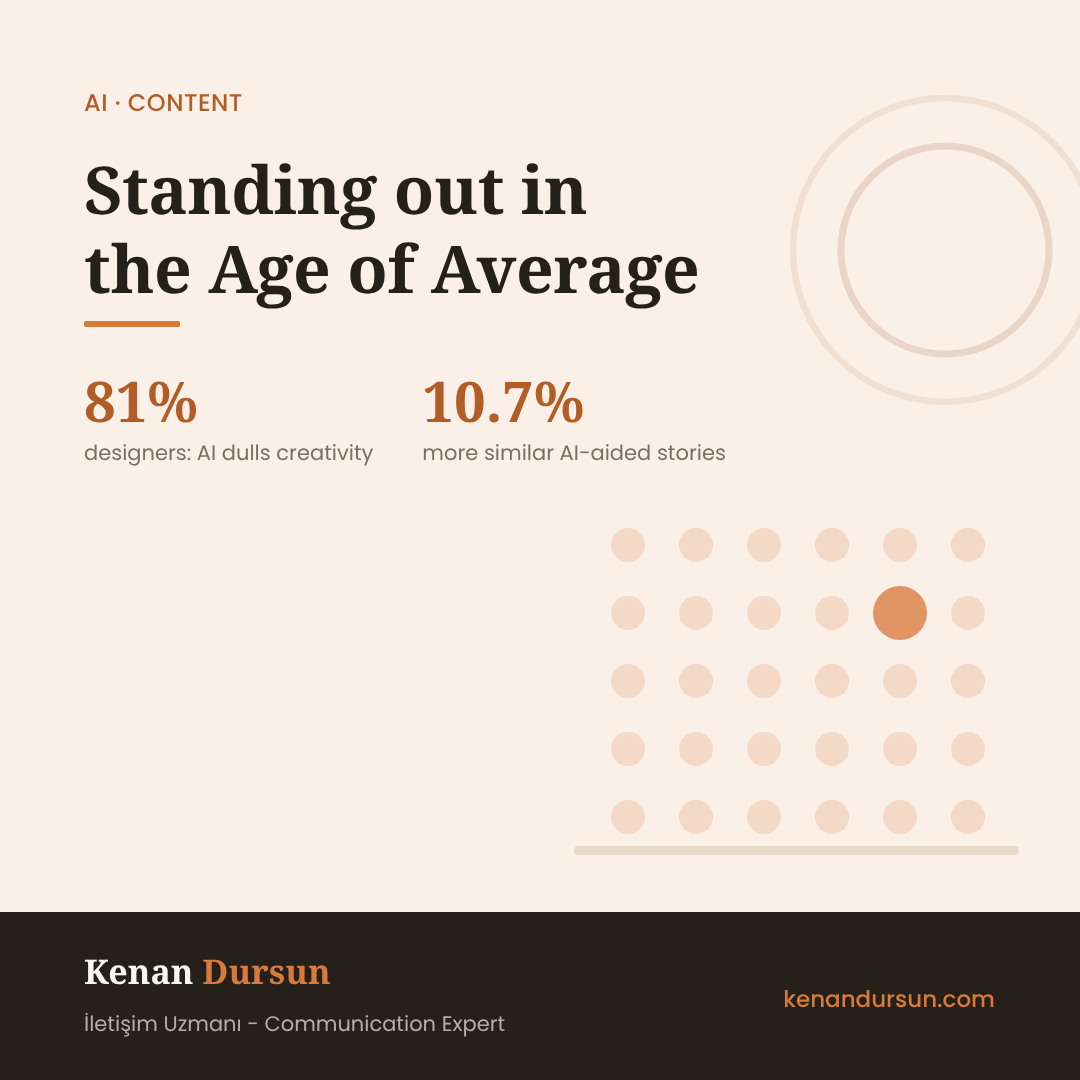
In an experiment published in Science Advances, Oliver Hauser of the University of Exeter and Anil Doshi of UCL asked 300 people to write short stories, which 600 people then evaluated. Writers with the most access to AI ideas scored 8.1% higher on novelty, and the biggest gains went to the less creative writers. But the other side of the coin was measured too: stories written with a single AI idea were 10.7% more similar to each other than stories written without help.
The researchers describe this as a "social dilemma". As individuals we produce better texts; as a group we build a more uniform pool of content.
A study presented at CHI 2025 by Cornell researchers Agarwal, Naaman and Vashistha goes a step further. In an experiment with 118 participants from India and the United States, AI suggestions pulled Indian participants' writing towards Western styles, and the efficiency gains went mostly to the Americans. For those of us writing in Turkish, or any language other than English, the warning should sound familiar: local idioms, local references and our own sentence rhythm can be sanded away without our noticing.
The creative industries feel it as well. In a survey of 500 creative professionals published in October 2025 by DIGIT Lab at the University of Exeter, 81% of designers said they believe AI dulls creativity (63% among writers and journalists). 78% of respondents agreed that AI-generated work often feels homogenised and is less likely to connect with audiences.
Turkey: the country that leans hardest on one tool
This debate matters even more in Turkey, where I work. According to the Digital 2026 report by We Are Social and Meltwater, 94.49% of AI-referred web traffic in Turkey came from ChatGPT, the highest share in the world against a global average of 80.92%. The same report found that 39.7% of Turkish internet users aged 16 and over had used ChatGPT in the past month (global average 26.5%). Senfonico's Homo Glitchus 2026 report also highlights this first place.
The picture is shifting. Statcounter, which measures differently, puts ChatGPT's share in Turkey at 75.75% and Gemini's at 21.56% for September 2026. Even so, concentration remains high. When most of a country's communicators consult the same model, that model's average easily becomes the sector's average.
Is taste the new skill?
With the rise of AI, for the first time the barrier of skill is swept away. Taste is the new skill.
Claire Silver, AI artist
The technology analyst Benedict Evans has long described machine learning as giving you "infinite interns". He describes ChatGPT the same way: an intern that can write a first draft, or a hundred first drafts, but you will have to check it. My addition: the person who decides which of those hundred drafts gets published is the one who actually owns the work.
Taste here is not an abstract aesthetic question. In practice it comes down to three things: knowing what to choose, knowing what to cut and knowing what never to say. It is the ability to recognise a sentence that does not fit your organisation's voice, however fluent it is, and delete it.
The Senfonico report uses two concepts that show why this matters more now. The first is EGC (Engineered Generated Content): content whose aesthetic choices come not from individual creativity but from patterns the algorithm has flagged as likeable. The second is trend nihilism: in the report's words, a nano trend now lives not for a week but for one algorithmic cycle of 6 to 8 hours. An organisation that chases every trend ends up running an account that looks like everyone else, not like no one else. Taste is being able to choose not to chase.
The return of imperfection: intentional flaws and friction
As smoothness becomes abundant, imperfection gains value. In its 2026 Design Trends report, published in December 2025, Canva declared the new year "Imperfect by Design". Its trends include "Notes App Chic", an aesthetic borrowed from phone note screenshots, and "Texture Check", which celebrates tactile, handmade surfaces. According to Canva, searches for "DIY" and scrapbook-style designs rose 90% in a year.
The idea has an intellectual history. In her 2011 book The Glitch Moment(um), artist and theorist Rosa Menkman reads the glitch not simply as a failure but as the moment a medium reveals itself. A flaw shows that there is a person, or a process, behind the work.
Friction is making a comeback too. For years marketing raced to remove every obstacle. A dentsu report on friction in customer experience argues that conscious moments of pause can make interactions more meaningful. Senfonico frames the trend as "the Friction Paradox": effortful pursuits such as knitting, ceramics and analogue photography are becoming new ways of making meaning.
Visibility now runs through original content
Originality is not only an aesthetic choice; it is a visibility issue. In an Anadolu Agency (Turkey's state news agency) story dated 13 October 2026, Turkish experts argued that in the AI era digital visibility is determined by original content and trust. One line from Bünyamin Saraç, co-founder of Indexa, stuck with me: success will shift from "How many clicks did we get?" to "How many times were we recommended for critical questions?"
The story refers to the GEO (Generative Engine Optimization) study, an experiment by researchers from Princeton and IIT Delhi presented at KDD 2024. Its finding: adding verifiable statistics, quotations and source citations to a text can increase its visibility in AI-generated answers by up to 40%. Keyword stuffing, on the other hand, offers little to no improvement and in some tests reduces visibility.
The click data points the same way. According to Pew Research Center data from March 2025, Google users who saw an AI summary clicked a result link on 8% of visits, compared with 15% for those who did not. If less content reaches readers, the content that does reach them needs to actually say something.
From prompt to context: in AI content creation, the input makes the difference
In 2025, Shopify CEO Tobi Lütke and AI researcher Andrej Karpathy argued for "context engineering" over "prompt engineering". The distinction matters. The point is not to find a magic command but to give the model the right information in the right order.
Two of the rules in Ethan Mollick's Co-Intelligence are useful here: treat AI like a person, but tell it what kind of person it is; and be the human in the loop. Or, as the Senfonico report puts it, you cannot ask for what you do not know. If you do not know your organisation, your audience and your field, the model has no option but to make them up for you.
| Dimension | Average content | Distinctive content |
|---|---|---|
| Source | The model's training data | Field notes, your own data, real testimony |
| Example | "A woman", "a village", "many young people" | A story with a place, a date and (with consent) a name |
| Language | Safe, formulaic, fits any organisation | Your organisation's own words, local idiom and rhythm |
| Structure | Three bullets, a question, a call to action | Whatever shape the subject needs |
| Visuals | Flawless, stock, "inspiring" | Real, sometimes imperfect, with context |
| Decision | The AI's first suggestion | An editor's choices, including what was cut |
| Transparency | Unclear | AI use clearly disclosed |
Seven steps to a distinctive voice for organisations
- Write your own idea first, then ask the AI. The Doshi and Hauser experiment suggests that when the first seed of an idea comes from AI, texts converge. Brainstorm with your team, on paper, first; use the model for the second round.
- Put your own data on the table. Application numbers, field observations, volunteers' own words. The lesson of the model collapse debate is that fresh, human-sourced data is the one thing not everyone has.
- Be local and specific. District, neighbourhood, date, person. Moving from an activity list to an impact story is the shortest route out of the average.
- Write a context document. A one or two page voice guide: who you are, who you speak to, three example texts you love, phrases you never use. Give it to the model at the start of every session.
- Keep a banned phrases list. "We are thrilled to announce", "add value", a long dash in every paragraph. Know the signals readers use to spot AI text and remove them.
- Add deliberate friction. Let important texts sit for a day, read them aloud, have someone else read them. Speed is not a virtue everywhere.
- Let a human make the final call, and say so. Editing, meaning choosing and cutting, cannot be delegated. Make your way of working visible as well (see below).
AI and ethics: say that you use it
Debates on AI ethics often stay at a grand scale, but at the level of an organisation they start with two concrete steps. The first is transparency: add a short note to your website explaining which tasks you use AI for and confirming that a person reviews every text. The second is consent: do not paste the personal details and stories of the people you serve into an AI tool without their permission. If data that "smells human" is valuable, respect for the people it belongs to matters just as much.
Frequently asked questions
What is model collapse?
Model collapse is the permanent degradation of AI models that are repeatedly trained on data produced by other models. According to the study by Shumailov and colleagues published in Nature in 2024, the first thing lost is the rare, unusual part of the data. Researchers at Rice University call the same phenomenon "Model Autophagy Disorder" (MAD).
What does "the Age of Average" mean?
It is a concept from strategist Alex Murrell's essay "The Age of Average". It describes how fields from architecture and car design to logos and film posters have converged because of testing and optimisation. AI, with its tendency to produce outputs close to the average, accelerates that convergence.
Can AI-generated content be original?
It can, but the originality comes from the context you provide and your editorial decisions, not from the model. When you use your own data, local and specific examples and a guide to your organisation's voice, and a person makes the final choice, AI-assisted content can be distinctive. Content produced with default settings tends to stay close to the average.
What are the harms of AI in content creation?
The best known are misinformation, copyright and privacy problems. A less discussed harm is homogenisation: in an experiment published in Science Advances, stories by writers who took an idea from AI were 10.7% more similar to each other. Cornell researchers have also shown that AI suggestions pull writing towards Western styles.
How will AI affect our future?
For content and communication, the biggest effect is that production becomes cheaper and content more abundant. Being visible in that abundance will require distinctiveness rather than speed: real data, local context, trustworthy sources and taste. Evidence that AI answer engines favour original content containing statistics, quotations and sources supports this direction.
Sources
- Shumailov, I. et al., AI models collapse when trained on recursively generated data, Nature, 2024
- Rice University, Breaking MAD: Generative AI could break the internet, 2024
- Alex Murrell, The Age of Average, 2023
- Doshi, A. R. and Hauser, O. P., Generative AI enhances individual creativity but reduces the collective diversity of novel content, Science Advances, 2024 (ScienceDaily summary)
- Agarwal, D., Naaman, M. and Vashistha, A., AI Suggestions Homogenize Writing Toward Western Styles and Diminish Cultural Nuances, CHI 2025
- Dezeen, DIGIT Lab (University of Exeter) survey of creative professionals, 2025
- Reuters (via Yahoo Tech), Reddit in AI content licensing deal with Google, 2024
- Turkish Minute, Turkey leads world in share of ChatGPT-driven web referrals (We Are Social and Meltwater, Digital 2026 data), 2026
- Statcounter, AI Chatbot Market Share Turkey, September 2026
- Claire Silver, The Concept of Qualia: A Sitdown with Claire Silver, Museum of Crypto Art, 2022
- Benedict Evans, Unbundling AI, 2023
- LBB Online, Canva Predicts 2026 Will Be Imperfect by Design, 2025
- Institute of Network Cultures, Rosa Menkman, The Glitch Moment(um), 2011
- dentsu, The Value of Adding Friction to the Customer Experience, 2025
- Anadolu Agency (via Yeni Çağrı), Yapay zeka çağında dijital görünürlüğü "özgün içerik" ve "güven" belirliyor (In the AI era, original content and trust determine digital visibility), 2026
- Aggarwal, P. et al., GEO: Generative Engine Optimization, KDD 2024
- Pew Research Center, Google users are less likely to click on links when an AI summary appears in the results, 2025
- Ethan Mollick, Co-Intelligence: Living and Working with AI, 2024
- Senfonico, Homo Glitchus: İnsanlık Hali (Homo Glitchus: The Human Condition), 2026
If you would like to think this through for your organisation, get in touch.
Join my WhatsApp community where we discuss civil society and communications.
Join the Community