What Is a Content Creator? The 2026 Creator Economy and Why Trust Is the New Currency
Organisations keep asking one question these days: "Should we work with a content creator, or should that budget go to ads?" Behind it sits a more basic curiosity. What is a content creator, how is a creator different from an influencer, and why do people seem to listen to them more than to institutions?
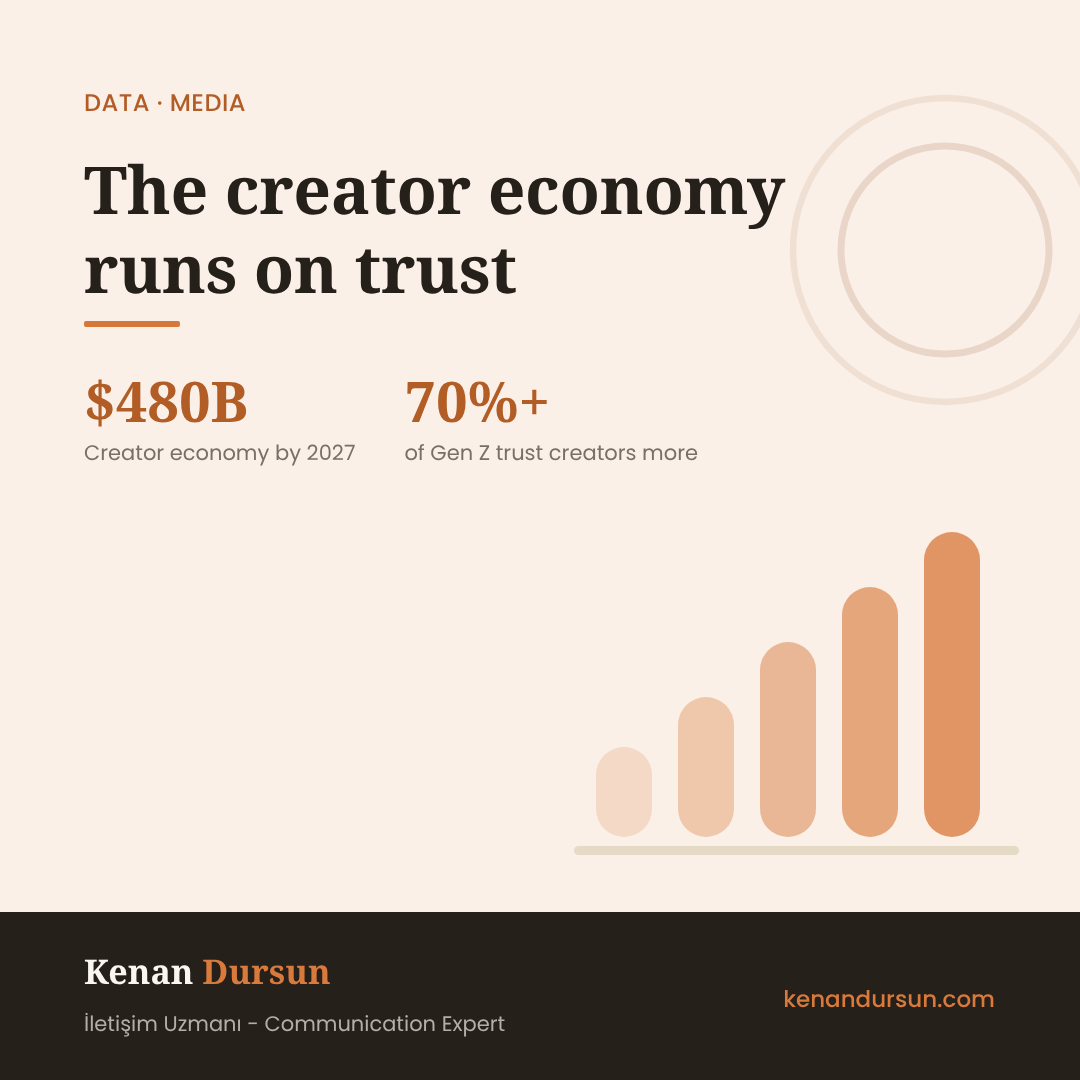
In this piece I start by pinning down the definition. Then I look at the numbers: according to Goldman Sachs, the global creator economy could approach 480 billion dollars by 2027. What interests me most, though, is not the size of this economy but what it actually runs on.
My short answer: trust. Follower counts are the shop window. The real capital is the moment someone says "try this" and people believe them. That is exactly where institutions, NGOs and communicators have something to learn.
What is a content creator?
A content creator is someone who regularly produces content, whether text, photos, video, audio or live streams, and shares it with an audience through their own channels. "Digital content creator" means the same thing, with the emphasis on production and distribution happening on internet platforms: YouTube, Instagram, TikTok, podcast apps, newsletter platforms.
Two things sit at the heart of the definition: consistency and an audience of one's own. A single viral video does not make someone a creator. A specialist who runs an organisation's social media accounts produces content too, but on behalf of the institution, not for an audience of their own. What sets a creator apart is that people follow the content because of who makes it.
Labels such as "Instagram creator" or "YouTube creator" simply narrow the definition to one platform. The platform changes; the logic does not: regular output, a recognisable voice and a community that trusts that voice.
Content creator, influencer and opinion leader: what is the difference?
In everyday language "content creator" and "influencer" are used interchangeably, but the distinction is useful. An influencer is defined by their effect on an audience and usually earns money through brand collaborations. A content creator is defined by what they make; they may never take an ad, earning instead from subscriptions, teaching or their own products. Every influencer creates content to some degree, but not every creator is an influencer.
A third concept is the opinion leader. An opinion leader's power comes from position, not from a channel: a village or neighbourhood head, a union representative, the doctor everyone in the area trusts. Social media often merges all three roles in one person.
| Criterion | Content creator | Influencer | Opinion leader |
|---|---|---|---|
| Defined by | The content they regularly produce | Their effect on an audience | Their standing and reputation in a community |
| Typical income | Platform revenue, subscriptions, teaching, own products, sponsorship | Brand collaborations and promotion | Often no direct income |
| Source of trust | Consistency and expertise | Closeness and identification | Experience, role and personal acquaintance |
| Watch-out for institutions | Wants to keep editorial independence | Hidden advertising and compliance risk | Withdraws if they feel used |
How big has the creator economy become?
In an analysis published in April 2023, Goldman Sachs put the creator economy at around 250 billion dollars and projected that it could approach 480 billion dollars by 2027. The same analysis estimates there are about 50 million creators worldwide, and that only 4% of them earn more than 100,000 dollars a year.
Ogilvy's Influencer Trends 2026 report, published in February 2026, builds on that forecast and shows where the growth is heading: into shopping. Mordor Intelligence values the social commerce market at 1.63 trillion dollars for 2025. According to Ogilvy, 58% of TikTok Shop's 1.6 billion users have bought something through the platform.
Turkey is moving in the same direction. At the IAB Connect event in December 2025, Nazlı Eda Kırali, chair of IAB Turkey's Influencer Marketing Steering Committee, said influencer marketing in Turkey closed 2024 with 6.27 billion Turkish lira of investment. DataReportal's Digital 2026 Turkey report counts 62.3 million social media user identities as of October 2025, equal to 70.9% of the population.
| Indicator | Figure | Source |
|---|---|---|
| Global creator economy (2023) | ~$250 billion | Goldman Sachs |
| Projection for 2027 | ~$480 billion | Goldman Sachs |
| Share of creators earning over $100,000 a year | 4% | Goldman Sachs |
| Global social commerce (2025) | $1.63 trillion | Mordor Intelligence |
| Influencer marketing investment in Turkey (2024) | TRY 6.27 billion | IAB Turkey |
| Social media user identities in Turkey (Oct 2025) | 62.3 million | DataReportal |
What does this mean? The size of the market shows that creating content is no longer a side hustle. But that 4% slice is a reminder too: the economy is large, while income is concentrated in very few hands.
Why is trust the new currency?
Ogilvy's report includes a figure attributed to The Drum: more than 70% of Gen Z say they trust creators and athletes more than traditional ads, or even celebrities. That is the signature of a trust economy, not just an attention economy.
The 2026 Edelman Trust Barometer shows the same mechanism from another angle. Among people who trust a finance influencer, 57% say that if that person endorsed a company they distrust, they would still trust the influencer and would trust or consider trusting the company. For food influencers the figure is 62%. In other words, trust can be transferred from a person to an institution. One caveat: Edelman's 2026 survey covers 28 markets and Turkey is not among them. These figures describe a global pattern, not Turkey.
Edelman calls this transfer "trust brokering": a set of practices and behaviours that counters insularity by facilitating trust across difference. A good creator does exactly that, translating between the language of their audience and the language of an institution.
The Turkish agency Senfonico's Homo Glitchus 2026 report gives this translation a less romantic name. Its "Homo Expertus" chapter argues that information overload has made decision-making exhausting; citing Ipsos data, it notes that 76% of consumers in Turkey say there is too much information and deciding is tiring. In that environment the influencer stops being an opinion leader and becomes an "information translator", even a "decision prosthesis".
They do not tell you what is most correct; they tell you what is least risky.
Senfonico, Homo Glitchus: İnsanlık Hali (The Human Condition), 2026; my translation
For me that sentence is the core of this piece. People trust creators not because they offer the most accurate information, but because they spare them from having to decide alone. That is why trust is both valuable and fragile: one bad recommendation or one hidden ad can wipe out capital built over years.
AI and virtual creators: where trust gets tested
As CNBC reported, in June 2025 two AI avatars in China generated more than 7 million dollars in sales during a single seven-hour livestream. According to a Forbes survey cited by Ogilvy, 58% of US users follow at least one virtual creator. Yet 37% of marketers doubt that AI creators can build trust.
These numbers belong together. AI can sell; but trust comes from knowing there is an accountable human behind the voice. As synthetic content multiplies, a real person's experience, face and even mistakes become more valuable.
The practical lesson for institutions is clear. An AI-generated "spokesperson" may look cheap in the short run, but it can be very expensive on the trust ledger. I looked at where AI does and does not belong in my piece on using AI in NGO communication; an organisation's voice and face are high on the list of things not to hand over.
What brands have learned: from one-off posts to long-term partnerships
To me, the most instructive finding in the Ogilvy report is this: 92% of brands prefer long-term creator partnerships over one-off activations. The reasoning is about trust. A creator mentioning a brand once is an ad. Mentioning it over months, based on genuine use, is a relationship, and audiences read that difference very well.
The next step is shared ownership. According to Ogilvy, Prime, founded by KSI and Logan Paul, passed 1 billion dollars in retail sales within two years, and MrBeast's Feastables passed 250 million dollars. Hailey Bieber's Rhode was sold to e.l.f. Beauty in 2025 in a deal worth up to 1 billion dollars. "Rented reach" is giving way to brands built together.
There is a weak spot in the picture, though: measurement. Citing SAMY, Ogilvy reports that 50% of marketers still cannot prove whether influencer marketing works, and 44% run campaigns without clear KPIs. The money is flowing, but many organisations do not know what they are buying.
Another shift the report points to is from the crowded feed to smaller rooms. According to Ogilvy data, 55% of users now prefer engaging with creators in private, curated online spaces, and brands active in these spaces see a 20% increase in loyalty. "Content loyalty programmes" grow out of the same idea: treating the audience as co-creators rather than viewers. The Nestlé Milo programme featured in the report drew 2,638 sign-ups and more than 78 million views.
Being a content creator in Turkey: the tax exemption and ad rules
Turkey's tax exemption for social media content creators
For international readers, Turkey is an interesting case because it has a specific tax regime for creators. Article 20/B (mükerrer) of the Turkish Income Tax Law grants an exemption for income from social content creation and mobile app development. It covers sharing text, images, audio or video on the internet and similar electronic media, as well as services such as individual lessons, training and product promotion offered there.
The core conditions: obtain an exemption certificate from the tax office, open a dedicated account for this activity at a bank established in Turkey, and collect all payments through that account. The bank withholds 15% income tax on amounts paid into the account; the law also allows the President to change that rate. The exemption applies only if income stays below the fourth bracket of the income tax schedule. Under General Communiqué No. 332, that threshold is 5,300,000 Turkish lira for 2026 (it was 4,300,000 lira in 2025). If the limit is exceeded, the exemption does not apply for that year and all income must be declared on the annual return.
How much does a content creator earn?
The honest answer: there is no reliable average for Turkey. Earnings vary widely by platform, audience size and quality, niche and how often collaborations come in. The global picture still gives a sense of scale: according to Goldman Sachs, only 4% of creators earn more than 100,000 dollars a year. This profession is not just the handful of big names you see; most creators work on modest incomes.
Mandatory ad disclosure
In May 2021 the Advertising Board of Turkey's Ministry of Trade published its "Guide on Commercial Advertising and Unfair Commercial Practices by Social Media Influencers". The guide bans hidden advertising. It requires posts made in return for money, free or discounted products to be labelled so that they are noticeable at first glance, prohibits recommending products the influencer has not tried, and requires filters in commercial images to be disclosed.
The framework was tightened in 2026. According to the Ministry, an amendment to the Regulation on Commercial Advertising and Unfair Commercial Practices, published in the Official Gazette on 1 July 2026, means that from 1 August 2026 influencers must clearly mark commercial posts with labels such as "reklam" (advertisement), "iş birliği" (collaboration), "sponsorlu içerik" (sponsored content) or "tanıtım" (promotion).
The key point for institutions: the guide holds the advertiser, the agency and the influencer each responsible. A company or NGO cannot shrug off a missing label as "the creator's problem". I see this rule not as a burden but as trust infrastructure. A clear label is the shortest way of telling an audience "I am not fooling you".
Five lessons for institutions and NGOs
What institutions can take from the creator economy has more to do with approach than with budget. These five lessons stand out for me:
- Build relationships, not posts. Instead of buying a single post for a campaign, build a partnership over months with a few creators who genuinely care about your issue. That is why 92% of brands prefer long-term partnerships: trust accumulates through repetition.
- Measure trust, not reach. Ogilvy recommends metrics such as repeat viewing, average watch time and consistency of comments over reach. Saves, shares and what people actually write in the comments tell you more than how many people you reached. I covered which numbers to watch in my piece on social media measurement for NGOs; the same logic applies to creator partnerships.
- Take micro and local creators seriously. A creator speaking from within a district, a profession or a community reaches fewer people than a name with millions of followers, but often carries more trust. If trust is moving from institutions to people's immediate circles, your messenger should come from those circles too.
- Make transparency the default. Put the ad label in the contract, respect the creator's editorial independence, and say so openly when AI has been used. Audiences sense when an institution is putting words in a creator's mouth; a voice that speaks freely is the one that persuades.
- Give your own experts a "creator mindset". Your field worker, lawyer or researcher may already be a trusted voice. Give them room to produce regularly, personally and in plain language. That is what "how to become a content creator" means inside an organisation: a clear area of expertise, a regular rhythm, a recognisable voice and a two-way relationship with the audience.
Frequently asked questions
What is a content creator?
A content creator is someone who regularly produces content such as text, photos, video, audio or live streams and shares it with an audience through their own channels. What defines them is consistency and an audience that forms around them. In Turkish the term is "içerik üreticisi".
What is a digital content creator, and is it the same as an influencer?
A digital content creator produces and distributes content on internet platforms. An influencer is defined by their effect on an audience and usually earns through brand collaborations. Every influencer creates content to some degree, but not every content creator is an influencer.
How do you become a content creator?
Start by choosing a clear area of expertise or interest, then produce regularly in that area with a recognisable voice. Building a two-way relationship with your audience matters more than follower numbers. In Turkey, once you start earning, you also need to learn the tax exemption conditions and the ad labelling rules.
How much does a content creator earn?
There is no reliable average for Turkey; earnings vary widely by platform, audience, niche and collaborations. According to Goldman Sachs, only 4% of the roughly 50 million creators worldwide earn more than 100,000 dollars a year. Income is concentrated among very few people.
What is Turkey's tax exemption for social media content creators?
Article 20/B of the Turkish Income Tax Law exempts creators who hold an exemption certificate and collect all payments through a dedicated account at a bank in Turkey from filing a return, in exchange for 15% withholding. The ceiling for 2026 is 5,300,000 Turkish lira; above it, all income must be declared. I recommend consulting a financial adviser about your own situation.
Sources
- Goldman Sachs, The creator economy could approach half a trillion dollars by 2027, 2023: goldmansachs.com
- Ogilvy, 2026 Influence Trends You Should Care About, 2026: ogilvy.com (PDF)
- Edelman Trust Institute, 2026 Edelman Trust Barometer Global Report: Trust Amid Insularity, 2026: edelman.com (PDF)
- Senfonico, Homo Glitchus: İnsanlık Hali, 2026 (report)
- Mordor Intelligence, Social Commerce Market Size and Share, 2026: mordorintelligence.com
- CNBC (via NBC Los Angeles), AI humans in China just proved they are better influencers, 2025: nbclosangeles.com
- CNN Türk, Influencer pazarlaması IAB Connect'te masaya yatırıldı (Influencer marketing discussed at IAB Connect), 2025: cnnturk.com
- DataReportal, Digital 2026: Turkey, 2026: datareportal.com
- PwC Turkey, 2026 Yılı Bazı Gelir Vergisi Rakamları (Selected 2026 income tax figures), 2026: pwc.com.tr
- Fatih Aras, GVK Mükerrer Madde 20/B: Sosyal İçerik Üreticiliği İstisnası (Social content creator exemption), 2026: fatiharas.com
- Republic of Türkiye Ministry of Trade, Guide for social media influencers published, 2021: ticaret.gov.tr
- Republic of Türkiye Ministry of Trade, A new era of transparent advertising on social media, 2026: ticaret.gov.tr
If you would like to think this through for your organisation, get in touch.
Join my WhatsApp community where we discuss civil society and communications.
Join the Community