Civil Society's Visibility and Trust Crisis: Why 89.9% of People in Türkiye Have No Relationship with Any NGO
If you work at a civil society organisation, it can feel as if everyone around you is part of civil society in some way. The meetings, the networks, the joint statements, the same accounts following each other. The data paints a very different picture: in Türkiye, the vast majority of people have no active relationship with any NGO at all.
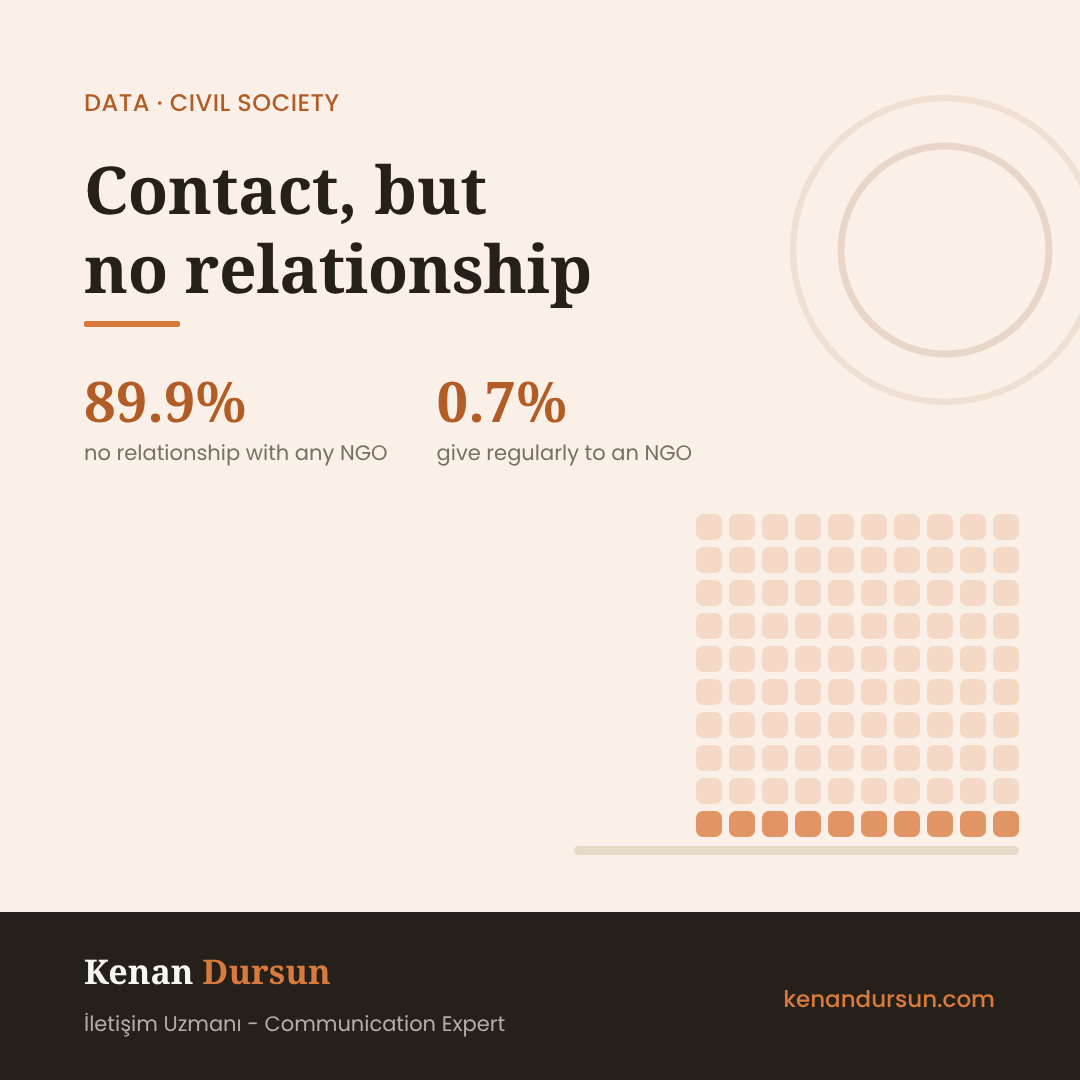
According to the Kömüre Veda (Farewell to Coal) Communication Guide, produced in 2026 by the European Climate Foundation (ECF), the agency Senfonico and the polling firm KONDA, and based on KONDA's 2025 Lifestyles survey, that share is 89.9%. Regular donors make up just 0.7%.
In this piece I put that number next to other evidence: TÜSEV's research on individual giving, the Edelman Trust Barometer, the Reuters Institute and a social media analysis by the YADA Foundation. My conclusion is simple. The problem facing civil society is not only a lack of resources. It is a problem of relationship and voice.
What is civil society, and what is an NGO? A short frame
Civil society is the space outside the state and the market where people come together voluntarily around a shared purpose. Civil society organisations (CSOs, or NGOs in everyday use) are the organised forms of that space: associations, foundations, platforms, informal initiatives, cooperatives. They are not for profit, and they work for a public good or for the rights of a community.
In Türkiye this space is not small. According to DERBİS data from the Interior Ministry's General Directorate for Civil Society Relations, there were 101,823 active associations as of January 2026. That figure does not even include foundations, trade unions or initiatives without legal personality. So the issue is not a shortage of organisations. There are more than a hundred thousand associations, yet most people connect with none of them.
89.9% of society has no relationship with any NGO
The Kömüre Veda guide reports KONDA's 2025 Lifestyles data as follows:
| Type of relationship with an NGO | Share of population |
|---|---|
| No active relationship with any NGO | 89.9% |
| Member of an NGO | 4.3% |
| Volunteer at an NGO | 2.4% |
| Donated in the past | 1.7% |
| Regular donor | 0.7% |
The row I keep coming back to is the last one. 0.7% means seven people in a thousand. Every conversation about the financial sustainability of civil society in Türkiye is, in effect, a conversation about those seven people.
The same guide cites another striking finding from KONDA's climate perception data. Asked who is responsible for tackling climate change, people point to the national government (55%) and municipalities (22%). Only 13% point to NGOs. People do not really see civil society as an active part of the solution.
Contact, but no relationship: what the TÜSEV data adds
At first glance this figure seems to clash with TÜSEV's Individual Giving and Philanthropy in Türkiye 2024 study, published in February 2025 by the Third Sector Foundation of Turkey. Led by Ali Çarkoğlu and Güneş Ertan and based on 1,408 face to face interviews, it found that the share of people giving through institutions rose from 18% in 2004 to 35% in 2024. Volunteering in NGOs rose from 6% to 13%, membership from 7% to 11%. Average trust in NGOs stood at 6.1 out of 10 (it had fallen as low as 4.9 in 2021).
So how do the two pictures fit together? I think the answer lies in what is being measured. One measures "any contact in the past year", the other "an ongoing, active relationship". TÜSEV's own earthquake finding shows the gap clearly: around 65% of the population took part in giving or volunteering after the February 2023 earthquakes, but only 13% kept it up on a regular basis.
In other words, people in Türkiye are generous. They act in a crisis, they give, they volunteer. But that contact does not turn into a lasting relationship. The Türkiye page of CAF's World Giving Report 2025 says something similar: the share of people who give in any form is above the European and global averages, volunteering is lower, and a lack of trust in NGOs is among the reasons some people do not give.
This is where civil society loses most: thousands of contacts made in a crisis quietly fall away once the crisis passes.
Trust in NGOs: what the global picture says
The 2026 Edelman Trust Barometer surveyed 33,938 people in 28 countries. One important caveat: Türkiye is not in the sample. The figures below describe a global trend, not Türkiye. But the trend is worrying enough for civil society everywhere.
In 2026, trust in NGOs stands at 58. In the report's own words, NGOs are the only institution whose trust did not rise. Trust in "my employer" rose to 78, business to 64, media to 54 and government to 53, while NGOs stayed flat.
Even more telling is the gap between expectation and performance. Edelman asked whether institutions have an obligation to help bridge divides in society, and whether they are doing it well:
| Institution | Say it is obligated | Say it is doing well | Gap (points) |
|---|---|---|---|
| My employer | 75% | 58% | 17 |
| Business | 73% | 47% | 26 |
| NGOs | 72% | 44% | 28 |
| Media | 75% | 40% | 35 |
| Government | 81% | 39% | 42 |
People expect a lot from NGOs, but do not believe NGOs are delivering. That 28 point gap is, to me, the shortest summary of civil society's communication problem.
Another finding shows where trust is moving. After the societal events of the past five years, net trust in neighbours, family and friends rose by 11 points, and in coworkers by 11 points. Net trust in national government leaders fell by 16 points and in major news organisations by 11. Trust is moving away from institutions and towards people close to us.
Civil society and the media: the carrier of trust is weak too
For years NGOs built their visibility through the media: press releases, news stories, interviews. In Türkiye that channel is itself losing trust. According to the Reuters Institute Digital News Report 2025, overall trust in news in Türkiye is 33%, the lowest level since 2015, placing the country 33rd of 48 markets.
This does not mean the relationship between civil society and the media is over. But it does mean that if an NGO's voice travels only through channels that are losing trust, it inherits that loss. Being mentioned in a news bulletin is no longer enough for people to trust you.
Institutional voice versus human voice
The YADA Foundation's Just Transition Communication Guide for Civil Society, published in 2026, includes a discourse analysis of 362 posts on X. One finding speaks directly to the question at the heart of this piece: institutional civil society actors produce a lot of content but get little engagement. In the political and institutional discourse group, the average was 11.9 likes per post. In the labour discourse group, dominated by opinion leaders and real individuals, it was 234.9.
I should note a limit here: the analysis covers X only, and the distribution on X does not represent society as a whole. The guide says so itself. Still, the direction is consistent: people listen to people, not to institutions.
The qualitative fieldwork behind the Kömüre Veda guide points the same way. For some audiences, activist and institutional NGO language destroys a message's credibility from the start. (The segment in question rests on a very small number of interviews, which the guide also notes.) Here is how I would summarise the difference between the two voices:
| Institutional voice (example) | Human voice (example) |
|---|---|
| "Within the scope of the project, our association carried out awareness activities in 12 provinces." | "I want to share one sentence I heard this week at a women's cooperative." |
| Logo, corporate account, press release | The name and face of a staff member, volunteer or beneficiary (with consent) |
| Visible at the start and end of a project | Always there, answering questions |
| "We must reduce carbon emissions." | "For cleaner air and healthier lives, we need to change the way we produce, together." |
| Gets loud when asking for money | Also talks when it is not asking for anything |
The last example is one of the language shifts the YADA guide itself recommends. The guide has dozens of them, and they share one principle: everyday life instead of technical terms, today's reality instead of distant targets.
Not only resources: relationship and voice
One of the things I hear most often in the WhatsApp community of civil society professionals I run is: "If we had the budget, we would be more visible." The resource gap is real; YADA's field meetings also highlight funding and the discontinuity of project-based work. But when I look at the data, money is not the whole story. Four patterns stand out:
- Project cycle communication. The organisation speaks when a project starts and when it ends, and is silent in between. Relationships need continuity.
- Visible only when asking. People mostly meet an NGO through a donation or petition request. That reduces the relationship to a one way transaction.
- Jargon. "Capacity building", "stakeholder engagement", "advocacy" mean something to us; to readers they are often a wall.
- Institutional voice. As trust moves towards people close to us, NGOs still speak from behind a logo.
None of these four requires a big budget. All of them require a change of habit.
Trust brokering: a role NGOs are missing
The concept at the centre of Edelman 2026 is especially relevant for civil society: trust brokering. Instead of trying to change people, it means surfacing the shared interests of groups who do not trust each other and translating their needs to one another.
A trust broker can be a person, organization, or institution trusted by each stakeholder group facing a common problem.
Edelman Trust Barometer 2026, Global Report
When I read that definition, local NGOs were the first thing that came to mind. A neighbourhood association, a women's cooperative, a disaster volunteer network: some of the rare places where people with different political views can still sit at the same table. Edelman's data shows that among low income respondents who say institutions broker trust well, the Trust Index reaches 67, compared with 49 for low income respondents overall. That is an 18 point difference. NGOs can take on this role, but only with a human voice that listens and translates, not an institutional voice that takes sides.
Seven steps for organisations: a relationship ladder from follower to donor
No campaign will close an 89.9% gap. But every organisation can build a relationship ladder that narrows it within its own circle: follower, participant, volunteer, donor. Here are the seven steps I recommend.
- Turn your team into messengers. Content told by a coordinator, a field worker or a volunteer under their own name and face beats a bulletin from the corporate account. Not everyone has to be a spokesperson; a few willing people are enough.
- Tell local, concrete stories. Not "activities in 12 provinces" but one person's story in one place. That means turning activity lists into impact stories, which I covered in from activity lists to impact stories.
- Simplify your language. Before publishing, read every text with one question in mind: would my mother understand this? The message transformation tables in the YADA guide are a good starting point.
- Show process and impact transparently. Explain where donations go, what worked and what did not. Rather than saying "trust us", make the process that earns trust visible.
- Be present in community spaces, all the time. A WhatsApp channel, a neighbourhood group, a newsletter. The Kömüre Veda guide argues that routine "always on" content gets lost in the noise when the goal is a campaign, and it is right. But building relationships is not a campaign: the goal here is not mind share but being someone who answers when asked. For WhatsApp's place in Türkiye, see the channel choice data.
- Broker trust. Plan an event or a content series that brings two distant groups (workers and environmentalists, shopkeepers and young people) together around one question. Surface the shared interest instead of taking sides.
- Put the next step on every rung of the ladder. An event invitation for followers, a small volunteering task for participants, a regular giving option for volunteers. Measure each rung separately: how many followers became participants, how many participants became volunteers?
Frequently asked questions
What is civil society?
Civil society is the space outside the state and the market where people organise voluntarily around a shared purpose. Associations, foundations, platforms, initiatives and cooperatives are all part of it. What they share is that they are not for profit and work for a public good or the rights of a community.
What is an NGO, and what does civil society organisation mean?
An NGO, or civil society organisation, is the organised form of civil society. In Türkiye the most common form is the association; according to Interior Ministry DERBİS data there were 101,823 active associations as of January 2026. Foundations and initiatives without legal personality are also referred to as NGOs.
How much do people in Türkiye trust NGOs?
TÜSEV's 2024 study puts average trust in NGOs at 6.1 out of 10, up from a low of 4.9 in 2021. But that trust does not turn into a lasting relationship: according to the Kömüre Veda guide, citing KONDA data, 89.9% of people have no active relationship with any NGO. In Edelman's global data NGOs were the only institution whose trust did not rise in 2026, though Türkiye is not in that sample.
What is the volunteering rate in Türkiye?
According to TÜSEV's Individual Giving and Philanthropy in Türkiye 2024 study, 13% of people volunteer with NGOs, up from 6% in 2004. The Kömüre Veda guide, citing KONDA's 2025 data, puts active volunteers at 2.4%. The difference most likely comes from the two studies asking different questions and defining volunteering differently.
How can NGOs become more visible?
The data suggests the most effective route is to put human voices ahead of the institutional voice, tell local and concrete stories, and simplify language. NGOs also need to be reachable all the time, not only when asking for donations, and to build a relationship ladder that turns followers step by step into participants, volunteers and donors.
Sources
- ECF, Senfonico and KONDA, Kömüre Veda Communication Guide (based on KONDA 2025 Lifestyles and climate perception data), 2026 (no public link found)
- TÜSEV, Individual Giving and Philanthropy in Türkiye 2024 (in Turkish), 2025
- Edelman Trust Institute, 2026 Edelman Trust Barometer Global Report, 2026
- Reuters Institute, Digital News Report 2025: Turkey, 2025
- YADA Foundation, Just Transition Communication Guide for Civil Society, 2026 (no public link found)
- Charities Aid Foundation (CAF), World Giving Report 2025: Türkiye, 2025
- Anadolu Agency, More than 100,000 associations in Türkiye (Interior Ministry DERBİS data, in Turkish), 2026
If you would like to think this through for your organisation, get in touch.
Join my WhatsApp community where we discuss civil society and communications.
Join the Community